Corporate Fountain of Youth
Why startups are the corporate fountain of youth, Europe’s top Series A+ novel fuel startups, and the "Energy as Defence" manifesto from Davos.

Open any newspaper or any screen this week, and you will see: the small Swiss town of Davos still draws the world’s elite.
Nearly 3,000 leaders from 130 countries attend the World Economic Forum. Yet its editorial edge is shifting: climate risks, long front and centre, have slipped down the forum’s Global Risks Survey, overtaken by geopolitics and economic confrontation.
Fewer hard climate commitments, more emphasis on “dialogue” and economic resilience.
Still, climate change remains—alongside all the other issues we face—a burning problem. That’s why in this issue of Deep Tech Now, we turn to Deep Tech minds passionately working on solutions.
Inside, you will find:
The Leap: Martin offers a fountain of youth for Europe’s corporate geriatrics—treat startups not as experiments, but as essential infrastructure.
Novel Fuels: Europe’s top 5 novel fuel startups are moving from pilots to scale-up, raising Series A+ funding to decarbonise aviation, shipping, and heavy industry.
Energy Security Is the New National Security: Fatih Birol, Executive Director of the International Energy Agency (IEA), sends a message from Davos.
Finally, while we wait for Isar Aerospace’s cinematic rocket to push upwards—following yesterday's pressurisation valve-related delay—use the time to apply for an office hour with Andreas Riegler, General Partner at APEX Ventures, who specialises in Space Tech.
Enjoy the read!
Dear all,
In recent weeks, I met several older people aging like jazz musicians—still improvising, open to learning and playing the new. We all know the other archetype: those turning into metronome minds—steady, predictable, and stuck.
Neuroscience backs both. Although dendritic spine plasticity falls by 20–40% in older brains, they can learn at rates similar to the young. Older brains can rewire, but need repetition and focus. Even if costlier, it remains possible if you choose to learn.
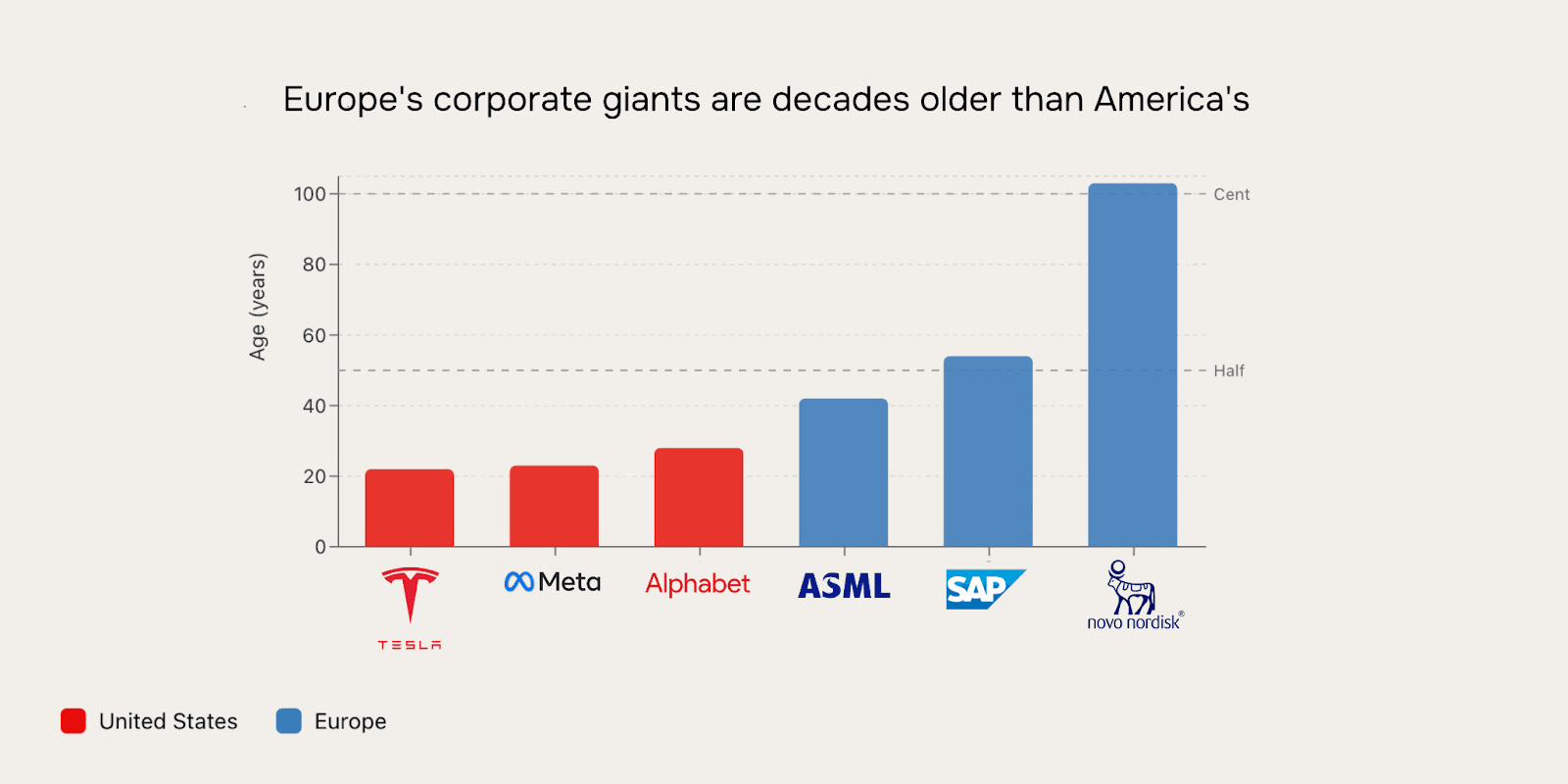
Now transfer this to companies: they age as people do. The top 10 US corporates by market cap are, on average, about 34 years old, fresh young professionals. In Europe? The top 10 are closer to 87 years old on average. More pensioners than pioneers. Alphabet (Google) is 28 years old (founded in 1998), Tesla is 23 (founded in 2003), and Meta (Facebook) will celebrate its 25th birthday in 2029 (founded in 2004). The youngest corporates in Europe’s Top 10? ASML at 42 years, SAP at 54 years — and then, brace for impact, Novo Nordisk at 103 years. These are Europe’s three “youngsters” in the Top 10 by market cap.
And this age comes with a price. Not because these companies lose intelligence, but because they accumulate certainty. Certainty about revenue streams, about their culture, about their processes. Every compliance scandal adds a new gate. Every failure adds a new form. Every crisis adds a new committee.
So what is the antidote? Not “acting young.” Not hoodies. Not hackathons. Not posting AI buzzwords on LinkedIn. One antidote for large corporations is collaborating with or acquiring startups.
When I look for innovation, I typically use three sources: the young, the new, and the fringe. Startups bring all three.
First: the Young. Young people are not valuable because they are energetic. They are valuable because they are closer to the edge of change. They detect shifts before your KPIs do. They don’t carry decades of “how we do things here,” which makes them annoying — and therefore essential. Partnering with or acquiring startups is the fountain of youth for incumbents.
Second: the New. People in new roles (even very experienced) apply learned patterns to a new context. Introducing a new tool, product, or mindset and merging it with the existing culture often creates a shock on both sides. But if managed well, it is an incredibly effective source of innovation.
Third: the Fringe. Most great ideas do not emerge in the core. The core is optimized. The core is political. The core has too much to lose. Innovation loves the periphery — the teams furthest from HQ, closest to unusual customers, forced to improvise. This is the world where most (AI & deep tech) startups operate. The fringe sees reality without filters. If your organization cannot hear or hire from the fringe, it will miss the future.
Many US companies have understood this – likely because they are relatively young. Over the last five years, American firms acquired roughly ~3–4 startups per Fortune 500 company vs ~1–2 in Europe. Silicon Valley firms are, again, in a different league (~12–15 acquisitions per company). To top this, US corporate acquirers capture more than 70% of Europe’s Deep Tech and life science M&A outcomes (~$24B since 2019). And it’s not only about acquisitions: a 2021 meta-study found that working with startups, external partners, and new technologies (“open innovation”) is linked to stronger financial results and innovation performance.
Startups are a revitalizer for corporate innovation. At a time when the European business model is under threat like never before in the last 30 years, it’s time to better leverage the fountain of youth of European (Deep Tech) startups. Why don’t we build a new European anti-aging playbook for startup-corporate innovation: collaborate earlier, adopt faster, scale harder. Let’s turn startups from a “nice-to-have” into core innovation infrastructure.
To a week of finding (and funding) your fountain of youth,
Martin
Metafuels | Adliswil, Switzerland
Technology: Power-to-liquid technology producing synthetic fuels from renewable electricity, green hydrogen, and captured CO₂, with a focus on scalable SAF production.
Customers: Airlines, fuel distributors, and infrastructure partners seeking early access to commercial e-fuel supply; currently collaborating with Swiss Paul-Scherrer-Institut and liquid energy and chemicals storage company Evos.
Use cases: Sustainable aviation fuel and synthetic hydrocarbons for long-distance transport.
Funding: $9 million oversubscribed Series A (January 2025), led by Celsius Industries, to advance from demonstration plants to commercial-scale projects.
Why it matters: Metafuels represents a new generation of European e-fuel companies moving rapidly from R&D into real-world commercial deployment.
Liquid Wind | Gothenburg, Sweden
Technology: Large-scale production systems for green e-methanol using renewable hydrogen and captured biogenic or industrial CO₂.
Customers: Shipping companies, fuel distributors, and industrial users seeking fossil-free liquid fuels; current partnerships with Övik Energi, Umea Energi, Uniper.
Use cases: E-methanol as a marine fuel, energy carrier, and feedstock for aviation and chemical industries.
Funding: Latest Series C funding exceeding €40 million (2024), complemented by public grants in 2025 to advance new e-methanol production facilities in Scandinavia.
Why it matters: Liquid Wind is helping establish e-methanol as a commercially viable fuel, particularly for shipping — one of the most challenging sectors to decarbonise.
INERATEC | Karlsruhe, Germany
Technology: Modular power-to-liquid (PtL) reactors converting green hydrogen and captured CO₂ into synthetic fuels such as e-SAF, e-diesel, and e-chemicals, designed for industrial-scale deployment.
Customers: Fuel producers, airlines, logistics companies, and industrial partners seeking drop-in, carbon-neutral alternatives to fossil fuels.
Use cases: Sustainable aviation fuel (SAF), synthetic diesel for shipping and heavy transport, and climate-neutral chemical feedstocks.
Funding: ~€70 million financing package (2024), including venture capital, venture debt, and public funding from the European Investment Bank and Breakthrough Energy Catalyst, supporting construction of Europe’s largest e-fuel production facility near Frankfurt - following a Series B funding in 2024 with €180 m.
Why it matters: INERATEC is among Europe’s most advanced e-fuel players, moving synthetic fuels from pilot scale toward industrial production — a critical step for decarbonising aviation and other hard-to-abate sectors.
OXCCU | Oxford, United Kingdom
Technology: Proprietary catalytic process that converts waste CO₂ and green hydrogen directly into sustainable aviation fuel in a single step, reducing complexity and cost compared to conventional PtL routes.
Customers: Airlines, fuel suppliers, and industrial partners aiming to secure long-term SAF supply.
Use cases: Production of synthetic aviation fuel to replace fossil jet fuel without changes to aircraft or infrastructure.
Funding: ~$28 million Series B (2025), following an earlier Series A, to scale demonstration plants and accelerate commercial deployment.
Why it matters: OXCCU targets one of aviation’s biggest bottlenecks — affordable SAF at scale — by simplifying chemistry and improving the economics of synthetic fuel production.
Carbon Neutral Fuels | London, United Kingdom
Technology: Power-to-liquid processes converting renewable electricity, water and CO₂ into synthetic aviation fuels.
Customers: Airlines, fuel producers, and public-sector stakeholders supporting domestic SAF capacity.
Use cases: Low-carbon aviation fuel production aligned with UK and EU decarbonisation targets.
Funding: Latest funding was a £6 million grant from the UK Department for Transport’s Advanced Fuels Fund (AFF), positioning the company for scale-up beyond pilot projects. This followed previous rounds by investors, matching the timing of their series B.
Why it matters: Carbon Neutral Fuels contributes to building a domestic SAF supply chain in Europe, supporting regulatory mandates such as ReFuelEU Aviation.
At the World Economic Forum in Davos, Fatih Birol, Executive Director of the International Energy Agency (IEA), delivered a clear message: energy security is no longer a technical background issue. It’s a core strategic and national security concern.
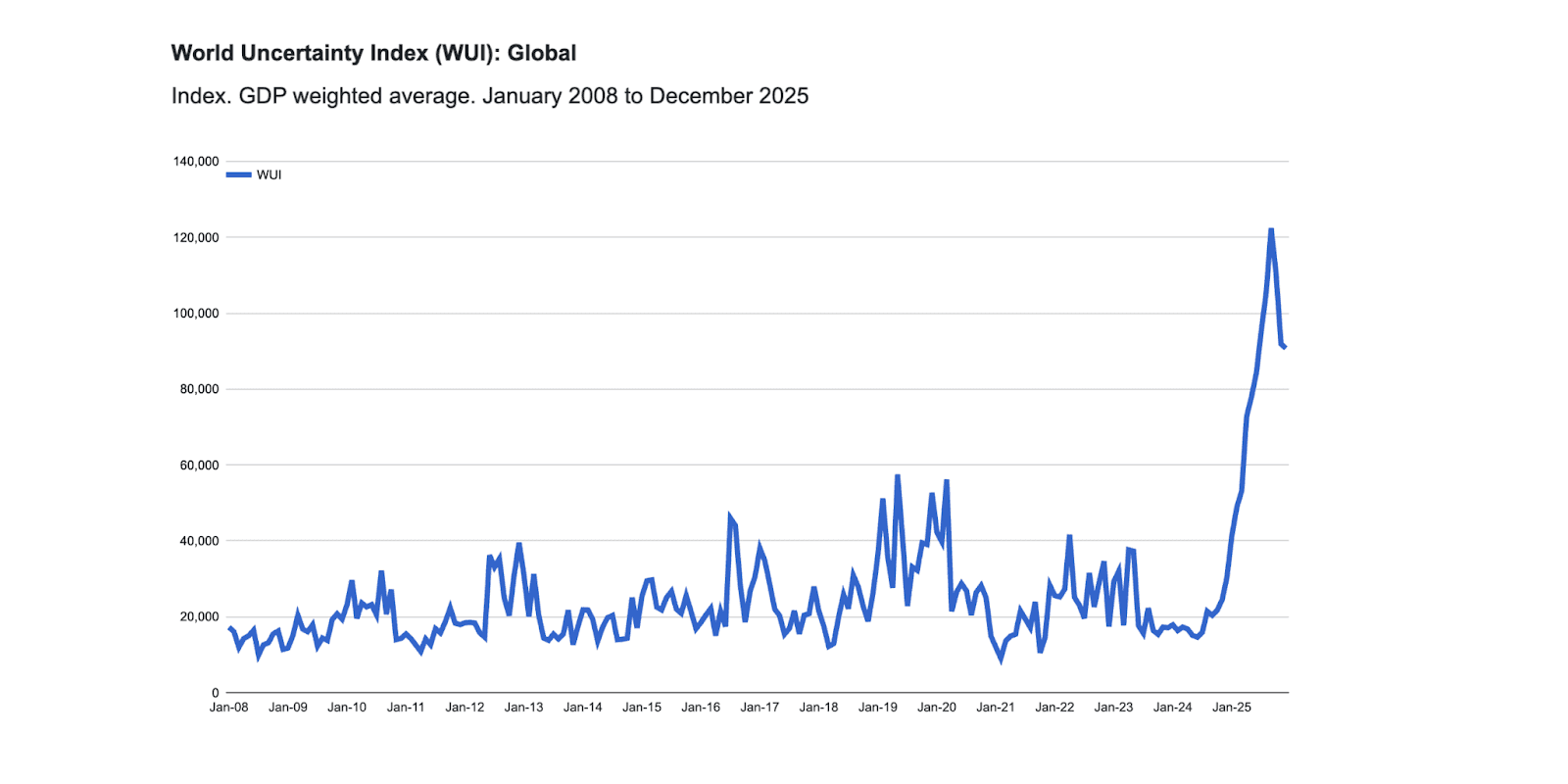
With the World Uncertainty Index hitting record peaks, Birol’s recent IEA commentary (7 Certainties about Energy for this Age of Uncertainty) lays out what policymakers and investors can rely on in an increasingly volatile global energy system.
Here are our favourite five takeaways:
Energy systems must be built for shocks, not stability.
The IEA argues that volatility — from geopolitical conflict to extreme weather — is no longer the exception. Future energy systems must be designed for disruption, flexibility and rapid recovery.Diversification is the first rule of resilience.
Countries that avoid single suppliers, single fuels, or single technologies are consistently better positioned. “Don’t put all your eggs in one basket” is no longer a slogan — it’s policy.Electricity demand is entering a new growth era.
AI, data centres, electric vehicles, and cooling are accelerating power demand globally, pushing electricity to the centre of energy systems for decades to come.Clean energy is becoming a security asset, not just a climate tool.
Renewables, nuclear power, and grids are now seen as ways to reduce import dependence and geopolitical exposure — not only to cut emissions.Predictability attracts capital — unpredictability scares it away.
Long-term investment in energy systems depends on stable policy frameworks and international cooperation; countries that offer this predictability will be the winners.
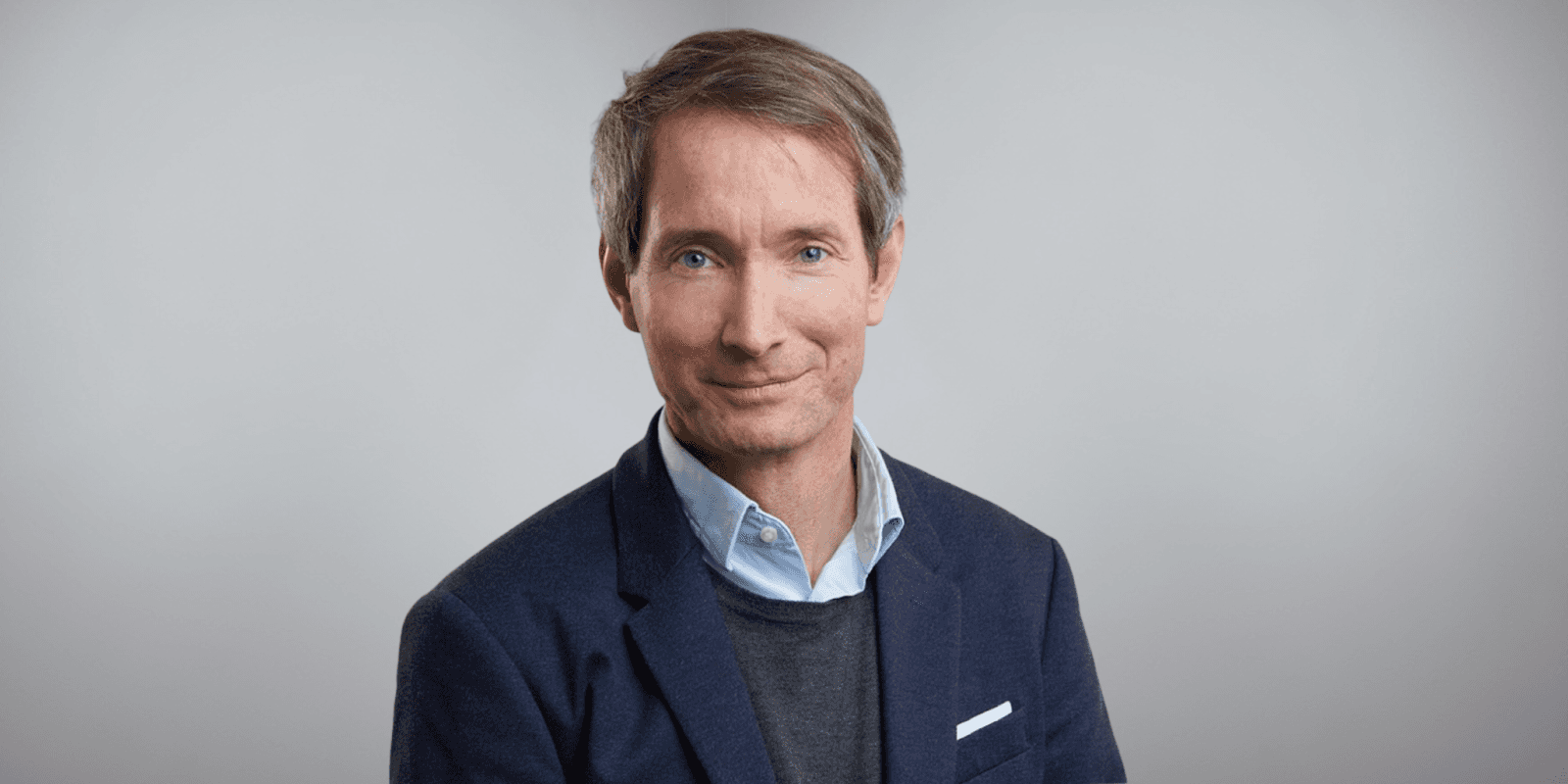
While we wait for Isar Aerospace’s cinematic rocket to push upwards—following yesterday's pressurisation valve-related delay—use the time to apply for this week’s Ecosystem Gift: an office hour with Andreas Riegler, Founder and General Partner at APEX Ventures.
Bringing extensive global experience as a senior executive in digital and tech services, along with advanced degrees from Harvard and TU Graz, Andreas specialises in Space Tech at APEX Ventures.
APEX Ventures is a European early-stage fund investing in startups grounded in unique, protectable technology.
→ Register your interest for the office hours here.

