Defence Tech Just Became Europe’s Fastest-Moving Market
Synthetic battlefields, faster procurement and a new generation of defence startups, plus a best-kept secret of getting investors to reach for the checkbook

Europe’s defence market is changing fast. Demand is rising not only for more equipment, but for systems that are cheaper, faster to produce, easier to upgrade and built around software, autonomy and AI. Startups are entering categories once dominated almost entirely by large primes.
That shift runs through this issue. We look at Europe’s top 5 defence startups building the next layer of synthetic training infrastructure, and we spoke with Ben Moores, former Procurement Adviser to the UK Secretary of State for Defence, about how defence demand and procurement are evolving.
Also in this issue:
Read in this week’s column by Martin Schilling: Frontier-tech founders win when they stop selling the technology and can express their customer value in one measurable sentence: Who gains how much, on which KPI.
A new Joint Research Centre analysis published early this September shows that Europe’s innovation gap may be more fixable than we thought.
Enjoy the read!
This is part of the book NORTH STAR: The 12 Formulas Behind the World’s Most Valuable Deep Tech and AI Companies. How Clarity Compounds into Capital, Customers, and Enterprise Value. Sign up HERE for the waiting list to be amongst the first to receive the book.
In the spring of 1956, a converted tanker called the Ideal X sailed from Newark to Houston with fifty-eight truck trailer bodies bolted to her deck. On the quay stood a former trucking magnate named Malcolm McLean, who was not a shipping man and therefore did not know which parts of shipping were supposed to be impossible.
Everyone in the ports knew that loading a ship was slow, filthy and expensive. Gangs of longshoremen carried cargo aboard piece by piece, a process called break-bulk, and it could take days and swallow most of the cost of a voyage. This was simply how the sea worked, and it had worked that way for as long as there had been ships.
McLean did not set out to build a better ship or a better crane. He asked a narrower question: what if you never unpacked the cargo at all? What if the trailer, sealed at the factory, went straight onto the ship and straight onto another truck at the far end, untouched? Break-bulk cost around $5.86 a ton in those days. The steel box cost about $0.16.
That number reshaped the planet. Within a few decades the box carried most of the world’s manufactured goods. McLean won because he could say, in one line, exactly whom he helped, by how much, and along which dimension of value.
In frontier tech we need to do the same. Many unicorn founders have told me the turning point came when they stopped talking about the technology and talked only about the product and the value. And there is a formula for it.
The formula
We help [ideal customer] gain [quantified value] on [dimension of value].
The ideal customer is a buyer with a budget. The quantified value has to sit on a dimension the customer already tracks, in the KPIs they would recognise as their own. A competitiveness buyer (e.g. an enterprise customer) earns revenue, so value resolves into revenue gained, cost cut or risk removed, priced in euros. A mission buyer (e.g. a defence ministry or a hospital) answers to a mandate, so revenue language breaks, and value resolves into capability, efficiency and sovereignty. The line runs by buyer, not sector: a pharma company buying a discovery platform is a competitiveness buyer, the health system treating the patient is a mission buyer.
Below, the dimensions that actually get paid for, checked against the value propositions of over fifty of Europe’s deep tech unicorns and scaleups.
Defence
Cost-per-effect (€ per neutralised threat)
Mass / deployability (units fieldable per year)
Sovereignty (% of supply chain foreign-free)
Space
Asset life / uptime (months of extra operational life)
Access cost & cadence (€ per kg to orbit, launches per year)
Data latency (hours-to-minutes for insight)
Advanced materials
Unit cost (€ per kg or per unit)
Supply independence (% less of a scarce input)
Manufacturing & robotics
Deployment speed (minutes to deploy, versus days)
Labour (% labour cut per cell)
Total cost of ownership (€ saved per cell per year)
Enterprise AI
Value recovered (€ or % of spend recovered)
Time saved (hours of work removed)
Sovereignty & compliance (% of data processed in-jurisdiction)
BioAI / TechBio
Time-to-candidate (years to candidate, 7–10 down to under 2)
Cost per candidate (€ per validated lead)
Clinical & diagnostic outcome (% accuracy uplift)
Energy
Levelised cost (€ per kWh or per MWh)
Dispatchability / uptime (hours of firm supply)
Carbon removal cost (€ per tonne CO₂ removed)
Understanding the unit of value really matters. Many, many frontier tech pitches I have seen do not reflect the KPIs of their customers sharply enough.
Here are some examples of a good value proposition.
Defence. We help air-defence units neutralise drones at roughly €1 a shot, moving cost-per-effect from millions to single-digit euros.
Manufacturing. We help high-mix suppliers cut robot programming from days to under half an hour, saving tens of thousands of euros per application per year.
Energy. We help grid operators store power two-thirds cheaper per kilowatt-hour, on a fireproof system rated for tens of thousands of cycles.
McLean never sold a steel box. He knew the number: $5.86 a ton became $0.16.
May your value proposition fit on a napkin, and your napkin sit on the CFO’s desk.
Martin

Source: private
Ben Moores is a former Procurement Adviser to the UK Secretary of State for Defence, with deep insight into how defence capability priorities translate into procurement decisions and industrial demand. He is now part of Merlyn Advisors UK, where he is helping lead a new defence technology fund focused on European, AUKUS and Gulf companies.
Which deep tech fields - autonomy, AI, advanced materials - are you seeing gain the most traction in defence procurement right now?
There is often a significant disconnect and delay between procurement financials and defence technology so what is happening today isn’t reflective of what is coming. Defence tends to be a slow, follower of commercial technology. Most wins are therefore people taking commercial technology and applying it to a defence problem. A lot of people talk about autonomy but there has been very little true autonomy yet. It’s absolutely coming though and autonomous medical vehicle extraction has shown how quickly adoption can occur. Cloud and AI are oft talked about and government is desperate to take up both but the real wins will be in the back office rather than kinetic in the near term with application of commercial based solutions. The key driver right now is cheap alternative PNT and that is driving huge demand in associated propulsion systems. Cloud will be next as, once adopted, it will allow for collaboration in the development and integration of command and control.
Which startup teams have impressed you most in the past year, and why?
Teams who understand the customer and the market and how their application of a technology can adapt a way of fighting.
From your vantage point, how should defence departments identify and select the startups worth bringing into procurement pipelines?
They shouldn’t. We need to drop the cosplay innovation theatre and clearly signal intent that we plan to break out and group up money for small to medium sized programmes that approach a problem set differently that deliver an actual capability even if it’s done at risk. That way at the end there is a reasonable chance of a product, a capability and a novel way of application of technology to a problem.
What helps a startup move from an early pilot or demonstration to a real procurement contract with a government defence body?
It’s politicians and senior military leaders cancelling programmes to free up money in order to approach a problem set differently. It’s about spending some political capital, showing real leadership and taking risk instead of having your photo taken in front of the old way of doing things.
What’s your top advice to a founder trying to navigate defence procurement for the first time?
Accept that it’s going to take a long time and that you will have to hold the hand of the revolving door of customers who need help to take the risk to change.

Here are five European startups building the synthetic training layer for defence – software environments that allow soldiers, drone operators and autonomous systems to train, rehearse missions and adapt to contested battlefield conditions before entering the real world.
→ All five companies sell to the mission buyer defined in The Leap above. Four already name a defence ministry or armed force among their public customers, three of them in the UK.
Agon | London, UK / Berlin, Germany
Technology: Synthetic battlefields for training and testing autonomous defence systems. Agon lets drones, counter-UAS systems and other AI-enabled platforms learn against adaptive adversaries in simulated combat environments.
Customers & Partners: No defence customers have yet been publicly disclosed.
Use cases: Autonomous-system training, reinforcement learning, adversarial testing and validation before live deployment.
Funding: $30M across pre-seed and Seed in 2026, backed by Lakestar, Lux Capital, XYZ Venture Capital, Northzone, 201 Ventures and D3.
Why it matters: Defence AI needs vastly more battlefield experience than physical ranges can realistically generate. Agon is trying to manufacture that experience in software.
→ The next generation of synthetic training will increasingly train machines alongside humans.
VRAI | Dublin, Ireland / Newcastle, UK
Technology: Data-driven simulation software that captures and analyses human-performance data from VR, XR and other training environments.
Customers & Partners: British Army, Royal Air Force, Irish Defence Forces, BAE Systems and Kongsberg.
Use cases: Pilot and crew training, performance assessment, immersive mission training and identifying skill gaps.
Funding: €5M Series A in 2025 led by Beringea, following earlier investment from Northstar Ventures and Enterprise Ireland.
Why it matters: VRAI makes synthetic training measurable, turning every simulation into structured data on how personnel actually perform.
→ The bigger shift: Militaries can increasingly optimise not just what soldiers train on, but how effectively they learn.
Hadean | London, UK
Technology: AI-powered synthetic environments for collective training, wargaming and large-scale battlefield simulation. Its technology can populate virtual worlds with AI-controlled civilians, adversaries and other actors.
Customers & Partners: UK Ministry of Defence and British Army, alongside defence partners including Booz Allen and Thales.
Use cases: Collective training, digital wargaming, mission rehearsal and live-virtual-constructive simulation.
Funding: $30M Series A in 2022, followed by additional strategic and bridge funding, including Booz Allen Ventures and the British Business Bank in 2026.
Why it matters: Hadean allows militaries to create complex exercises involving far more actors and variables than physical training alone can support.
→ Military training is moving from individual simulators toward persistent, interconnected digital battlefields.
Skyral | London, UK
Technology: AI-enabled modelling and simulation platform that builds large-scale synthetic environments combining military units, infrastructure, civilian behaviour and information flows.
Customers & Partners: UK Ministry of Defence and British Army; part of the Omnia Training consortium alongside Raytheon, Rheinmetall, Capita and Cervus.
Use cases: Collective training, digital twins, mission rehearsal, wargaming and testing operational decisions.
Funding: $20M Series A in 2025 led by NOIA Capital, with participation from Accrete Capital.
Why it matters: Skyral goes beyond modelling weapons and units by simulating the civilian, infrastructure and information systems surrounding a conflict.
→ Synthetic battlefields are becoming digital twins of entire operating environments, not simply virtual firing ranges.
LVCim | Aix-en-Provence, France
Technology: Mixed-reality and Live-Virtual-Constructive simulation software for military aviation and drone training, including configurable UAS simulators and connected synthetic environments.
Customers & Partners: Public references include France’s Ministry of the Armed Forces, DGA, Dassault Aviation and Defence Conseil International.
Use cases: Drone-operator training, aircrew preparation, mission rehearsal and tactical data-link simulation.
Why it matters: LVCim is making defence simulation less dependent on building a separate training system for every individual aircraft or drone.
→ The bigger shift: Training infrastructure is becoming software-defined and increasingly platform-agnostic.
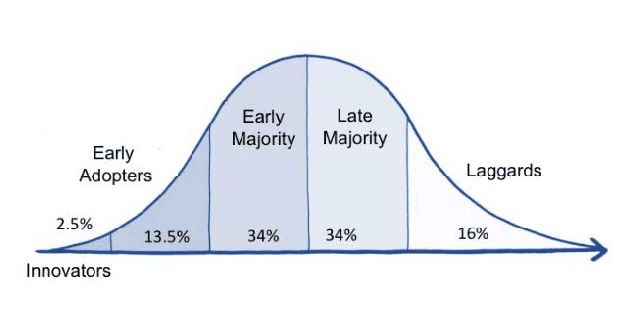
Rogers adoption/innovation curve. Adapted from Rogers, E. (2003). The Diffusion of Innovations. Fifth Edition. The Free Press, New York.
A new Joint Research Centre analysis published early this September examines three reforms proposed under the European Innovation Act: a common framework for valuing intellectual property and two measures to make public R&D procurement more innovation-friendly. Using the JRC’s RHOMOLO regional economic model, the study estimates that these reforms could generate €256–452 billion in additional cumulative EU GDP over ten years and support up to 507,000 jobs at peak impact.
Here’s five key take-aways:
Europe’s bottleneck is commercialisation, not research. The EU continues to produce strong science, but too little of it becomes scaled products and companies. The Innovation Act targets that conversion gap directly.
IP could become a financing asset, not just a legal asset. A standardised EU-wide framework for valuing patents could unlock an estimated €2.7–10.2 billion in additional IP-backed financing per year, giving deep-tech companies another route to capital beyond equity.
Public procurement is an underused industrial-policy lever. The JRC estimates that every euro spent on R&D procurement can generate around €3 in supplier returns through technological learning, new products and improved production processes.
The scale of the prize is material. Under the JRC’s more conservative scenario, the reforms still add almost €256 billion in cumulative GDP over a decade; in the higher-impact scenario, the figure rises to nearly €452 billion.
Regulation can be an innovation instrument. The broader message is that Europe may not need only larger subsidy programmes. Better rules around IP, financing and procurement can create significant economic impact at comparatively low fiscal cost.
In a nutshell: Europe’s competitiveness problem is increasingly a conversion problem – from research to IP, from IP to financing, and from financing to first customers. Fixing those interfaces may matter as much as increasing R&D budgets themselves.
From Circuit to Product: WE Day at MotionLab.Berlin | 24 September | Berlin, Germany
Powered by Würth Elektronik, this full-day hardware event focuses on one of the hardest transitions in deep tech: moving from a working prototype to a robust, manufacturable product. The programme combines engineering talks, hands-on workshops and direct access to Würth Elektronik specialists, covering topics such as EMC testing, wireless communication in industrial environments, connector behaviour and power electronics.
The day also includes a keynote by Alexander Gerfer, CTO of Würth Elektronik eiSos, a founder-focused panel and open lab access, giving teams the chance to bring along prototypes and discuss concrete technical challenges with engineers on site.
Why go: Particularly relevant for hardware and industrial deep-tech founders who are already building and need to de-risk the engineering decisions that can delay certification, manufacturing and market entry.
24 September 2026, from 10:00 | MotionLab.Berlin, Bouchéstraße 12/Halle 20 | €10 for external guests
Register here
Hack the Future: Construction Robotics Hackathon | 27–30 November | Aachen
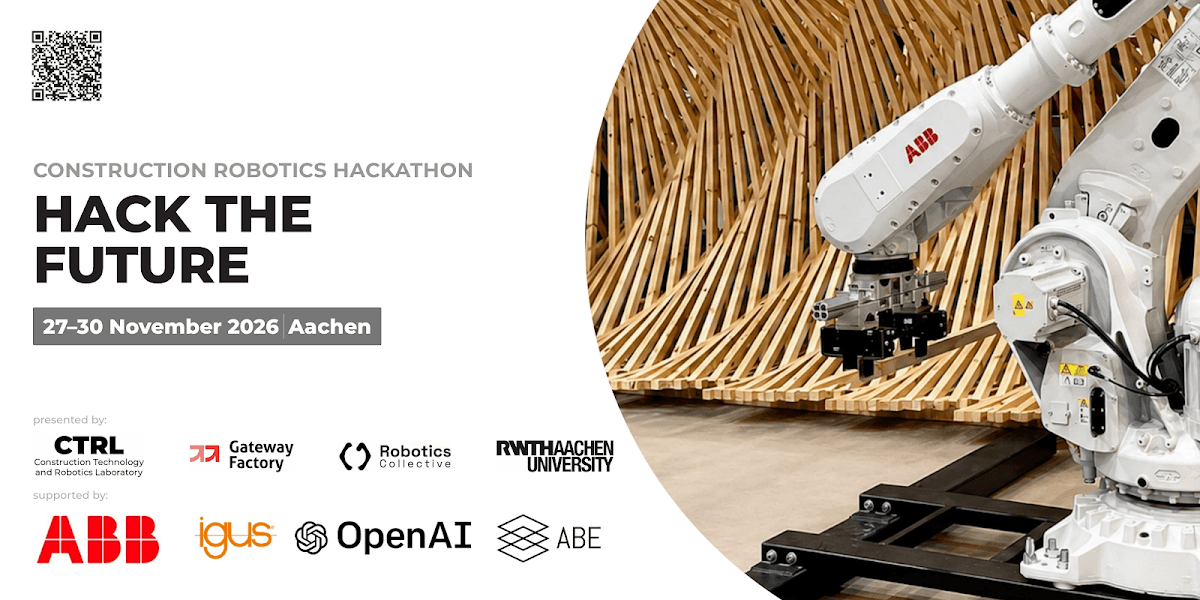
Robots are leaving the factory floor and heading to the construction site – and we’re looking for the students and builders who want to be part of that shift first.
From November 27–30, CTRL (RWTH Aachen), Gateway Factory and Robotics Collective Aachen are hosting the Construction Robotics Hackathon in Aachen: four days to prototype real robotics solutions for real construction challenges, working with actual hardware from ABB, igus and Siemens, plus AI infrastructure and token credits from OpenAI.
Expect a kickoff with challenge briefings and team formation, a full build sprint with mentor office hours and technology clinics, and a demo day in front of an industry jury – with prize money on the table. Challenges span assembly and installation, surface finishing, construction logistics, and perception and safety, all set by construction companies bringing their own real-world problems to solve.
Who should go: This is built for Engineering and CS students, makers, and anyone curious about applied AI and hardware – no construction background required, just curiosity and the will to build. Teams form on-site, so come solo or bring your crew.
Spots are limited – sign up via the QR code or apply here.
And here are more upcoming Tech Events worth the trip: We scanned the calendar for the most interesting tech gatherings coming up in Europe – here are three worth having on your radar.
Europe Tech Connect 2026 | 5 October, Munich and 6 October, Berlin
Organised by the Singapore Economic Development Board (EDB), Europe Tech Connect brings a delegation of senior Singapore demand players to Germany to meet European deep-tech companies ready for commercial partnerships. Participating organisations include Changi Airport Group, the Civil Aviation Authority of Singapore, Land Transport Authority, Maritime and Port Authority of Singapore, Ministry of Transport, ST Engineering Ventures and TechX Ventures.
The focus areas span agentic AI, robotics and Physical AI, industrial AI, digital twins, energy and electrification, quantum technologies, nuclear operations and climate tech. The format starts with reverse pitches from the Singapore organisations, followed by curated 1:1 meetings with selected companies.
→ For startups with a tested MVP and commercial readiness, it is a concrete opportunity to explore customer projects, technical partnerships, market entry into Singapore and potential investment.
Register interest by 25 September 2026: Munich, 5 October | Berlin, 6 October
European Microwave Week 2026 | 4–9 October | London, UK
Europe’s flagship gathering for RF, microwave, millimetre-wave, radar and semiconductor technologies combines three major technical conferences with the continent’s largest RF and microwave exhibition. This year adds dedicated Defence, Space, Automotive and 6G Forums, linking core component technologies directly to strategic end markets.
Why go: A particularly strong event for understanding the enabling hardware beneath Europe’s defence, space and communications ambitions – from radar and electronic warfare to satellite connectivity and next-generation wireless systems.
International Astronautical Congress 2026 | 5–9 October | Antalya, Türkiye
The 77th International Astronautical Congress brings more than 6,000 participants from across the global space sector together for five days spanning launch, satellites, exploration, science, infrastructure and space policy. It remains one of the few gatherings where agencies, established aerospace groups, emerging space companies, researchers and governments operate in the same ecosystem.
Why go: Space is rapidly becoming both commercial infrastructure and a strategic sovereignty layer. IAC offers one of the broadest views of where new capabilities, government programmes and private capital are converging.
CPHI Milan | 6–8 October | Milan, Italy
One of the world’s major gatherings for the pharmaceutical value chain returns to Milan, connecting companies across biotechnology, pharmaceutical manufacturing, ingredients, machinery, supply chains and contract production. The event is particularly relevant as biopharma moves toward more automated, data-driven and flexible production infrastructure.
Why go: For deep tech, the interesting story is upstream of the drug itself: bioprocessing, manufacturing equipment, automation and new production platforms are becoming strategic infrastructure as Europe looks to retain more pharmaceutical capability onshore.

