Europe Has Enough Power. Now It Needs Intelligence.
Isar Aerospace reaches orbit, Siemens Energy’s deep tech scouting playbook, and why the strongest deep tech teams are complementary by design
In Utrecht, one of the Netherlands’ fastest-growing cities, new electricity connections have effectively been frozen since July as the local grid struggles to absorb rising demand. Of roughly 15,000 companies waiting for a connection in the Netherlands last year, only around 700 got one.
What looks like a local bottleneck is increasingly a European warning: Europe’s energy transition has hit a new kind of scarcity: not electrons – grid capacity.
So, Europe clearly needs more cables, substations and transformers. But grids take years to build. In the meantime, the existing system has to become much smarter. That is why this week we selected 5 European startups building the intelligence layer of the power system.
Also, we spoke with one of our Guardians, Katharina Peterwerth, VP of Business Strategy for Grid Technologies at Siemens Energy. She says the company is scouting startups across digital grid technologies, advanced materials, HVDC, robotics, automation, AI and predictive maintenance — but always with a clear customer problem in mind.
Also in this issue:
Complementary by design: Deep Tech Momentum’s Martin Schilling argues that domain expertise, commercial skill, execution, trust and clear roles compound into the credibility investors and customers ultimately bet on.
Isar Aerospace reached orbit and deployed payloads on its second Spectrum flight, marking a major step for sovereign European access to space.
Is Europe finally moving from strategy to scale? We unpack five signals from the European Commission’s new State of the Digital Decade 2026 — and why Europe’s technology challenge is increasingly about speed, capital and deployment rather than invention.
Enjoy the read!
This is part of the book NORTH STAR: The 12 Formulas Behind the World's Most Valuable Deep Tech and AI Companies. How Clarity Compounds into Capital, Customers, and Enterprise Value. Sign up HERE for the waiting list to be amongst the first to receive the book.
Munich, 2017. A university workshop after hours, a handful of students, and a rocket engine they had built themselves. It was the most powerful cryogenic hybrid propulsion system in Europe, developed by people who did not yet have their degrees.
Then the phone started ringing. Companies asking to buy the engine. And Daniel Metzler, who ran TU Munich's 40-person student rocketry group, WARR, at the time wondered: who buys rocket engines from students?
The answer turned out to be a company. In 2018, Daniel Metzler, Josef Fleischmann and Markus Brandl incorporated Isar Aerospace, and it held together for the reason the best founding teams do: no one of them could have built it alone. Metzler ran it and sold it, the CEO who never pictured himself in sales and became its commercial engine anyway. Fleischmann owned the machine end to end and carried it to the launch pad as CTO. Brandl owned the part that must not explode: the engine.
Last Saturday, on only its second flight, Spectrum reached orbit, the first private European company to put satellites there from continental soil. The rocket was the important part everyone could see. But the part that actually decided it was a team crazy enough to risk it.
Every meeting is a Bayesian walk
Investors know what those first customers knew. The product will change and the market will surprise everyone; the one thing that compounds, or breaks, is the team. So investors, committees, and quietly the customers deciding whether to trust a deep tech team all bet on the team.
They do it with maths, whether they name it or not. Have you ever heard about the Bayes' theorem? Every new piece of evidence nudges a belief up or down. You walk in with a starting probability, and often it is brutal: a few percent of venture-backed teams ever return a fund, and in enterprise deep tech most first conversations die in the pipeline and never become a contract. Every slide, every answer, every reply now is new evidence. Green flags nudge it up. Yellow flags nudge it down. Below the bar, you get a no.
No single flag is fatal. DeepL grew into a two-billion-dollar company under what was effectively a solo founder, one yellow overwhelmed by evidence everywhere else. But yellows compound: three small ones multiply into a no that none alone could have produced. Here are the eight flags to be aware of — the ones your deep tech team is judged on.
The eight team flags
Flag | Green | Yellow |
|---|---|---|
Domain expertise (founder-market fit) | Patents, PhDs or published work in the exact domain; lived the problem; insider access to the buyer | Co-founders missing key technical parts of their own product |
Completeness & team size | 2–3 co-founders spanning domain and business-building | Solo founder; more than 4 co-founders; no plan to fill the gaps |
Sales skills | CEO owns investor relations and can sell; a fast path to revenue | Hundreds of investor conversations, no close; no LOIs or paid pilots |
Validation & execution | 30+ deep customer conversations; replies within hours; prior founding experience | In love with the solution, not the problem; sloppy documents |
Ambition | A clear vision to build a category leader; explicit about wanting VCs | Unclear whether they want VC money at all; a CV of sub-2-year jumps |
Tightness (history together) | Worked together professionally for over a year before founding | Met a couple of months ago; visible tension on calls |
Commitment & co-location | All co-founders full-time, in one city | A part-time co-founder with no plan to go all-in; a scattered team |
Role clarity | A clear CEO and CTO, COO or CSO where the problem demands it | Missing titles; Co-CEOs |
What green looks like
ICEYE (space). Two founders who built radar nanosatellites together at Aalto from 2012, with a CEO–CSO split fixed on day one.
Helsing (defence). A serial entrepreneur, an ex-defence-ministry insider, and a machine-learning lead. The procurement door was open before the product existed, because one founder had worked behind it.
Mistral (enterprise AI). Three founders who studied together at École Polytechnique, then built frontier models at DeepMind and Meta. Two even co-authored the original LLaMA paper.
So audit yourself against the eight flags before anyone else does.
With wishes for a complete team above all else. Rockets are hard. Complete teams are harder. Build the second one first.
Martin

Source: Isar Aerospace
A major milestone for Europe’s space ecosystem: Isar Aerospace successfully reached orbit and deployed payloads on only its second flight, becoming the first commercial European space company to place satellites into orbit from Continental Europe. The Spectrum rocket lifted off from Andøya, Norway, on 5 September, completing stage separation, second-stage ignition, orbital insertion and payload deployment as planned. The mission is more than a technical success: it gives Europe a new sovereign launch option at a time when access to orbit remains a strategic bottleneck. Isar Aerospace is now scaling production, with vehicles 3–7 already in build and a new 40,000 m² facility designed for up to 40 launch vehicles per year.
Source: Siemens Energy
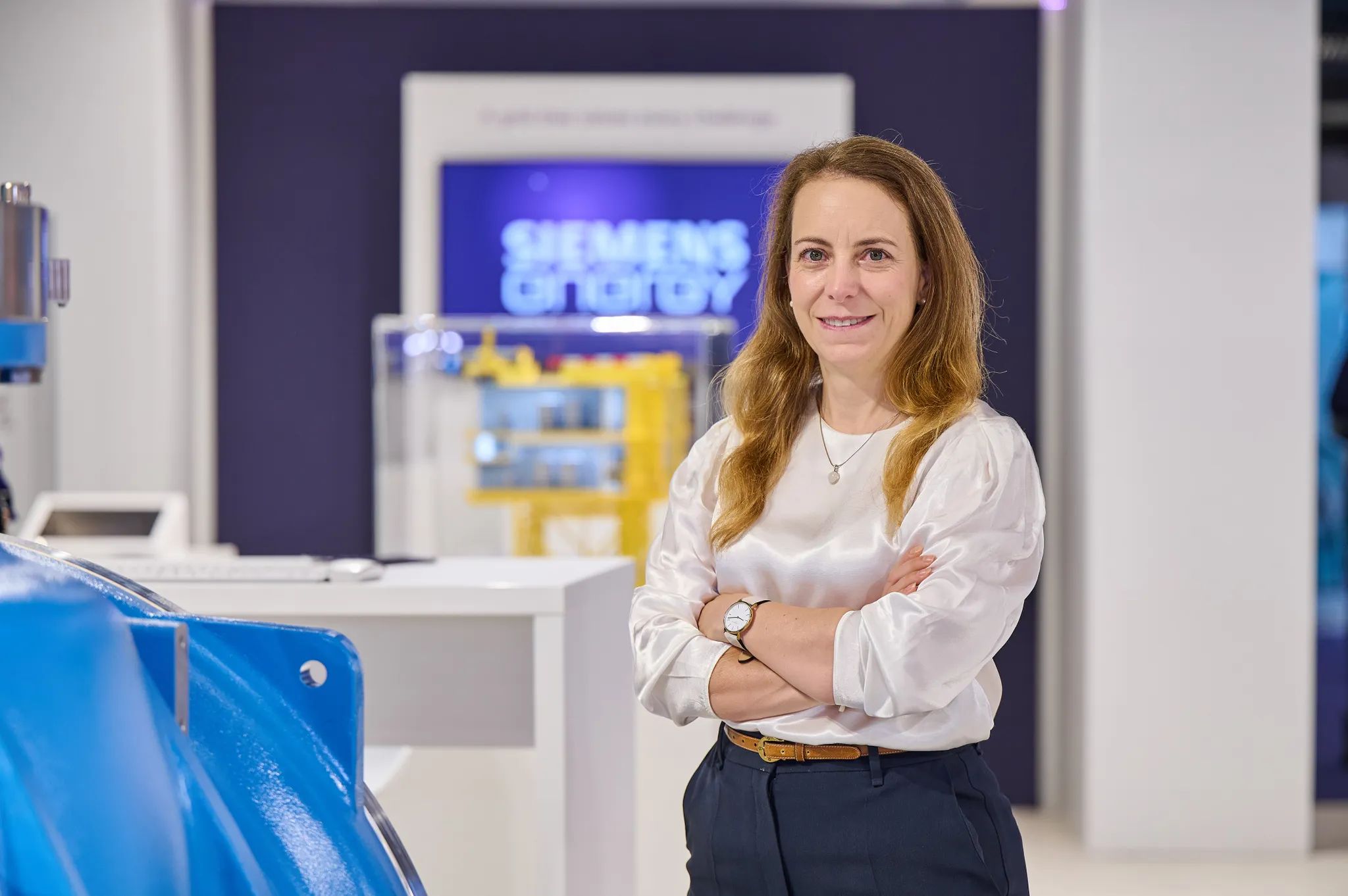
Dr. Katharina Peterwerth is Vice President Business Strategy for Grid Technologies at Siemens Energy, where she shapes the division’s growth, transformation and technology strategy for the power grids of the future.
Which deep tech fields are you most actively scouting startups in right now?
Our startup scouting is closely linked to the strategic priorities of Grid Technologies and, ultimately, to the challenges our customers are facing as power systems become larger, more digital, and more complex. One key area of focus is Digital Grid. We are particularly interested in technologies such as asset digitalization, grid software, protection and control systems, cybersecurity, and software platforms that help customers operate increasingly complex networks with greater visibility and resiliency. We are also actively exploring next-generation technologies that have the potential to shape the future of the grid. These include digital twins, advanced materials, solid-state technologies, medium-voltage DC applications, and next-generation HVDC systems.
How about certain technologies?
Beyond customer-facing technologies, we see significant opportunities in robotics, automation, and AI. Whether it is improving manufacturing efficiency, enhancing safety, enabling more autonomous grid operations, accelerating engineering and decision-making, or increasing productivity across our own operations, these technologies have the potential to create meaningful value throughout the organization. We are also exploring innovation opportunities in service-related areas such as asset performance management, predictive maintenance, lifecycle optimization, and operational efficiency, helping customers maximize the value and resiliency of their infrastructure. Ultimately, we are not looking for technology in isolation. We are looking for innovations that solve real customer challenges, strengthen our capabilities, and help accelerate the transformation of the energy system.
What helps a startup move from an early pilot to a genuine commercial partnership at Siemens Energy's scale?
Successful pilots are designed with scale in mind from the very beginning. While proving technical feasibility is important, commercial success requires more than a successful demonstration. Startups need to show that their solution can generate tangible business value and solve a problem that matters to customers. Strong internal sponsorship is also critical. The best partnerships are supported by stakeholders who are committed to driving adoption and who understand how the solution contributes to broader business objectives. Ultimately, commercial partnerships emerge when a solution can deliver repeatable value across multiple applications, customers, or geographies. At that point, it moves beyond being an interesting pilot and becomes a capability that can support long-term growth and customer success.
Five startups turning procurement, consumption, storage and flexibility into one increasingly programmable market.

trawa | Berlin, Germany
Technology: Integrated B2B energy platform combining electricity procurement, energy supply, energy management software and the flexible control of distributed energy assets such as battery storage. trawa uses consumption and market data to help industrial and commercial customers optimize when they buy, consume and store electricity.
Customers: Industrial companies, Mittelstand businesses, logistics operators, retailers, hospitality groups and other energy-intensive commercial customers. Named customers include FlixTrain, Maritim Hotels and Conrad Electronic. trawa says it now works with more than 250 companies across Germany and Austria.
Use cases: Electricity procurement, portfolio optimization, energy cost reduction, peak-load management, battery dispatch, self-consumption optimization and managing exposure to volatile power prices.
Funding: €24M Series A in May 2025 led by Headline, with participation from Norrsken VC and existing investors Balderton Capital, Speedinvest and AENU.
Why it matters: European industrial competitiveness increasingly depends not only on how much electricity companies consume, but on how intelligently they procure and manage it. trawa is turning energy procurement from a largely contractual function into an operational software layer that connects purchasing decisions with consumption and distributed assets.
→ trawa says its customers can reduce annual electricity costs by up to 30%, highlighting how energy intelligence is becoming a direct lever for the competitiveness of Europe's industrial base.
Etalytics | Darmstadt, Germany
Technology: AI-powered industrial energy intelligence platform combining digital twins, predictive analytics, physical models and autonomous control to optimize complex energy systems in real time. Its etaONE platform focuses particularly on heating, cooling, ventilation and other energy-intensive infrastructure.
Customers: Data centres, automotive manufacturers, chemical and pharmaceutical companies and other operators of mission-critical industrial infrastructure. Customers include Volkswagen, Equinix, NTT, Digital Realty and Merck.
Use cases: Data-centre cooling optimization, HVAC control, industrial energy management, predictive system control, anomaly detection and real-time reduction of electricity consumption and operating costs.
Funding: €16M Series A in October 2025, including an €8M extension led by M12, Microsoft’s Venture Fund, following an initial €8M Series A led by Alstin Capital with participation from ebm-papst and Technologiefonds Hessen.
Why it matters: Some of Europe’s biggest efficiency gains are hidden inside existing industrial infrastructure. etalytics attacks that layer directly: instead of replacing physical systems, it makes factories, data centres and process plants operate more intelligently. That matters as electricity demand rises while industrial margins remain under pressure.
→ etalytics reports energy reductions of up to 50% for cooling, heating and ventilation systems and is using its latest funding to expand across North America, Europe and Asia.
Capalo AI | Helsinki, Finland
Technology: AI-powered virtual power plant and trading platform for battery energy storage and renewable assets. Capalo combines forecasting, automated multi-market trading, optimization and route-to-market infrastructure to continuously dispatch storage across electricity and balancing markets.
Customers: Battery developers, infrastructure investors, renewable energy producers and independent power producers. Partners and customers include FRV, Renewable Power Capital, Ardian-owned eNordic Evergreen, MW Storage, Nordic Solar and European Energy.
Use cases: Battery trading, revenue stacking across electricity markets, renewable-plus-storage optimization, grid balancing, curtailment reduction, hybrid solar and battery management and maximizing lifetime asset value.
Funding: €11M Series A in February 2026 led by Heartcore Capital, with participation from Tesi and existing investors VentureFriends, PROfounders, Inventure and Innovestor.
Why it matters: Europe is deploying batteries rapidly, but installed capacity alone does not create a flexible electricity system. The value comes from deciding, continuously, when those batteries should charge, discharge or remain available for grid services. Capalo is building that decision-making and market-access layer.
→ Capalo AI now manages 1.6 GW of contracted battery capacity across six European markets, with 600 MW already live under trading and optimization as of August 2026.
Bohr Energie | Toulouse, France
Technology: Independent aggregation and energy-market platform combining artificial intelligence, production forecasting, optimization algorithms, market analysis and regulatory infrastructure to manage distributed renewable generation and battery assets.
Customers: Independent renewable energy producers, project developers, IPPs, utilities and electricity suppliers operating solar, wind, hydro and storage portfolios.
Use cases: Renewable power trading, production forecasting, battery and hybrid-asset management, participation in balancing markets, management of negative electricity prices, collective self-consumption and real-time optimization of distributed generation portfolios.
Funding: €10M Series A in August 2026 led by Suma Capital through its SC Net Zero Ventures fund, with participation from Irdi Capital Investissement, GSO Capital and Crédit Agricole, alongside existing investors Varsity, Founders Future and AFI Ventures.
Why it matters: Europe’s power system is becoming more fragmented as thousands of renewable and storage assets replace a smaller number of centralized generators. Bohr provides the aggregation layer required to turn those individual assets into coordinated, market-responsive infrastructure.
→ Bohr Energie already manages more than 170 assets and is targeting close to 1 GW under management by the end of 2026, illustrating how quickly independent aggregation is becoming core infrastructure for decentralized electricity markets.
Axle Energy | London, United Kingdom
Technology: Distributed energy flexibility platform connecting EVs, batteries, heat pumps, solar systems and other flexible assets to electricity markets. Axle provides the APIs, optimization software and market-access infrastructure required to aggregate thousands of devices into dispatchable virtual power plants.
Customers: Energy suppliers, automotive manufacturers, EV charging companies, device OEMs and fleet operators. Customers and partners include Pod, myenergi and Easee, with Axle designed to operate behind the customer-facing applications of utilities and hardware manufacturers.
Use cases: Smart EV charging, battery optimization, demand response, virtual power plants, flexibility trading, smart energy tariffs, solar curtailment and aggregation of distributed devices into tradable megawatts for electricity markets.
Funding: $25M Series A in August 2026 led by Energize Capital, with continued participation from Accel, Picus Capital and Eka.
Why it matters: Europe’s future grid will increasingly depend on millions of assets sitting behind the meter. EVs, batteries and heat pumps can either become an additional burden on electricity networks or a massive distributed flexibility resource. Axle is building the infrastructure that allows those devices to participate directly in energy markets.
→ Axle now connects around 300,000 live devices representing approximately 2 GW of shiftable load capacity and says it has already delivered hundreds of gigawatt-hours of flexibility to the grid.
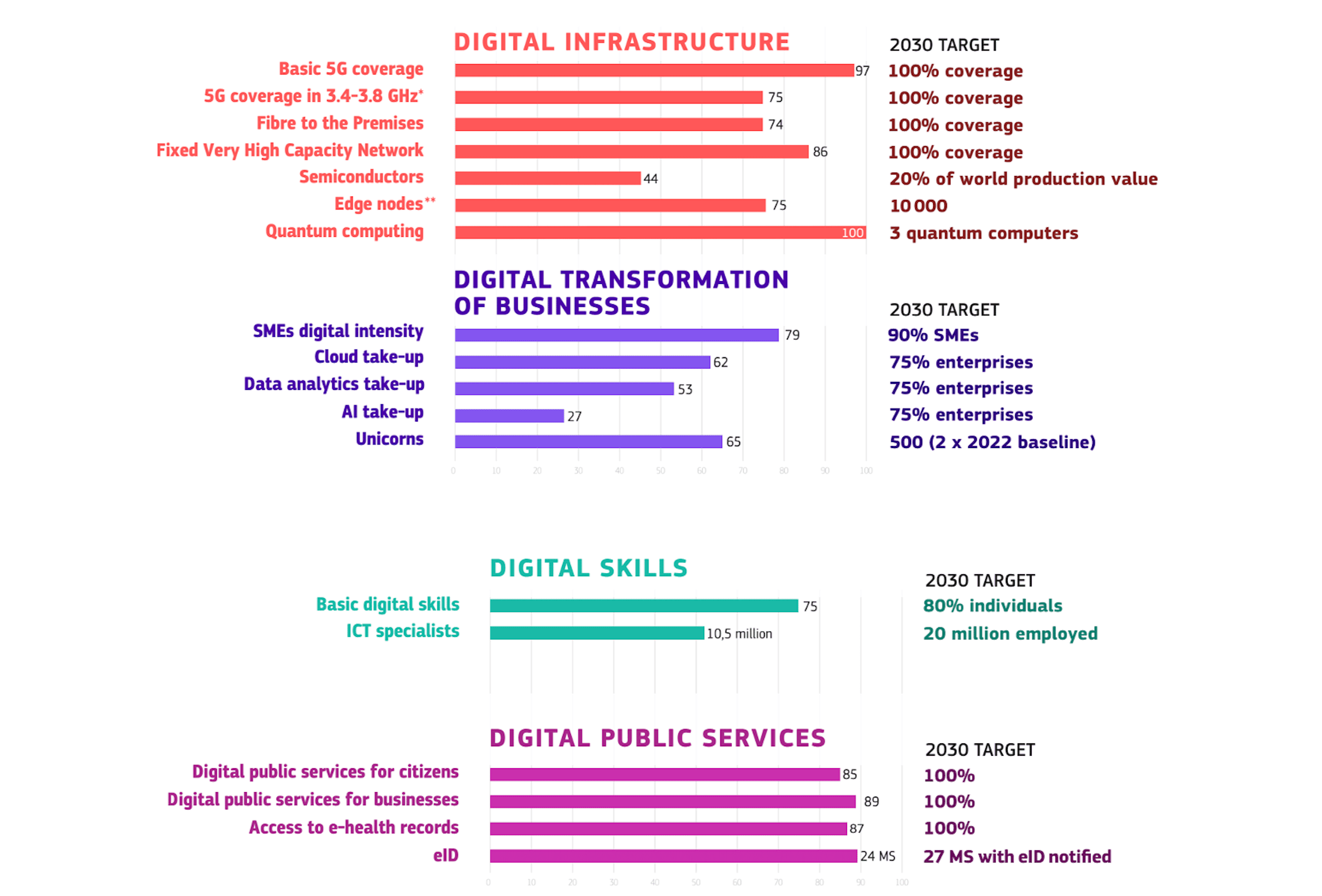
The 2026 State of the Digital Decade Report spotlights progress toward the 2030 objectives and targets. Source: State of the Digital Decade 2026
The European Commission’s newly published 2026 State of the Digital Decade offers a useful reality check on Europe’s technology ambitions. The direction is clear: Europe is building stronger digital foundations, but deployment, scale and investment continue to lag behind the speed of global competition.
Here’s five takeaways.
1. Europe is investing, but not yet at the required scale.
EU Member States have now committed 1,934 measures worth €289.3 billion under their national Digital Decade roadmaps, including €205.9 billion in public funding. That is substantial. But the report’s broader message is that Europe still faces structural investment gaps across critical digital infrastructure and advanced technologies. → The issue is increasingly not whether Europe has a technology strategy, but whether it can mobilise enough capital behind it.
2. Europe’s startup engine is stronger than its scale-up engine.
Europe counted more than 20,000 advanced digital startups in 2025, yet only a relatively small share managed to scale into large global technology companies. That gap between company creation and company scaling remains one of Europe’s most persistent weaknesses. → Europe does not lack innovation. It still lacks enough mechanisms for turning innovation into market power.
3. AI adoption is now a competitiveness metric.
The Commission increasingly treats the adoption of AI and other advanced digital technologies by European businesses as an economic competitiveness issue, not simply a technology-policy objective. Building European AI capabilities matters, but deploying them across industrial companies, SMEs and public infrastructure matters just as much. → The next frontier is diffusion: technologies create strategic value only once they move beyond the startup ecosystem and into the wider economy.
4. Technological sovereignty is shifting from rhetoric to infrastructure.
Europe’s sovereignty agenda is becoming increasingly tangible, spanning semiconductors, cloud, AI infrastructure, open-source technologies and strategic digital capacity. The Commission’s recent Tech Sovereignty package — including Chips Act 2.0 and new cloud and AI measures — reinforces this direction. → Strategic autonomy is no longer primarily about owning individual technologies. It is about controlling enough of the underlying stack to retain economic and political room for manoeuvre.
5. Europe’s next challenge is execution.
The report notes that 64% of the country-specific recommendations issued in 2025 have already been addressed. Progress is real. But Europe is simultaneously entering a period of faster technological change, greater geopolitical competition and rising infrastructure requirements. The benchmark is therefore moving while Europe is implementing. → Europe’s central technology question is shifting from what should we build? to how quickly can we deploy, finance and scale it?
We scanned the calendar for the most interesting tech gatherings coming up in Europe — here are three worth having on your radar.
IBC | 11–14 September | Amsterdam, Netherlands
A major meeting point for media and technology, with companies from more than 170 countries converging around AI, cloud infrastructure, cybersecurity, private 5G, immersive technologies and next-generation production. Its new Future Tech Ignite programme also puts greater emphasis on startups and emerging technologies moving toward commercial deployment.
Why go? A strong cross-industry signal on how AI, connectivity and immersive technologies are moving from experimentation into scaled commercial infrastructure.
NORDEEP 2026 | 16–17 September | Espoo, Finland
The fifth edition of NORDEEP brings together 750+ participants, 200+ startups and stakeholders from more than 10 countries around the commercialisation of European deep tech. This year’s tracks range from Physical AI and robotics to chips, photonics, quantum, engineered biology, advanced materials, energy, security and space.
Why go: Particularly relevant for founders raising capital or looking for industrial partners: the programme is built around matchmaking, investor meetings and moving technology from research into commercially scalable companies.
DeepTech Ventures Summit 2026 | 17–18 September | Luxembourg
Powered by Technoport, the DeepTech Ventures Summit convenes a deliberately curated group of 300 founders, investors, corporates, research organisations and ecosystem leaders around one of Europe’s central challenges: turning scientific excellence into industrial scale. The programme covers AI, quantum, energy and fusion alongside biotech, space, defence, mobility, cyber and advanced materials, with dedicated startup showcases and 1:1 matchmaking.
Why go: Less conference, more European lab-to-market infrastructure. A useful room for anyone working at the intersection of technology transfer, deep-tech financing and cross-border industrial partnerships.

