Europe Has the Helions. Where Are the Microsofts?
Why Europe's next champions need customers, not more grants. Plus: 5 molecule startups solving the energy crisis and the rise of AI factories.
When frontier technologies become strategically important, serious buyers do not wait for perfect maturity. They create the market signal early.
Case in point: this week, Meta signed an agreement with Overview Energy, a space-based solar startup, to secure early access to up to 1 gigawatt of power for its data centres by the end of the decade — years before commercial delivery is expected.
Europe still produces world-class science and ambitious deep tech startups. But too often, the first large customer, the first serious commercial risk and the first scale contract emerge elsewhere. That gap matters. Because in deep tech, supply follows demand. Capital follows revenue visibility. And founders scale where buyers move first.
That's why Deep Tech Momentum founder Martin Schilling asks a simple question in his column: What would it take for Europe to become the world's most powerful launch customer for its own deep tech and AI champions? And he finds 5 ideas to build the missing demand stack.
Also in this issue:
Agenda Highlight: The Venture Clienting & CVC Summit at DTM26 — Europe's top 100 Venture Clienting and CVC leaders, 12 working roundtables, one thesis: corporates must buy, not just invest. Co-hosted with 27pilots.
Top 5 Startups Building Molecules for Hard-to-Abate Industries: The companies making the new fuels and material inputs Europe needs for steel, aviation, chemicals, shipping, defence — and industrial sovereignty.
Technology Deep-Dive: The World Economic Forum's new Intelligent Industrial Operations Outlook 2026 argues Europe's next industrial edge won't come from cheaper labour but from AI-powered factories, supply chains and service networks. Five key takeaways.
Dear all,
May 10, 2023. Everett, Washington.
Helion Energy — a fusion startup — had never generated a single commercial kilowatt. That morning, its CEO David Kirtley announced that Microsoft had agreed to buy its electricity by 2028 — not as a pilot, not conditionally, but as a binding power purchase agreement with financial penalties if Helion failed to deliver. Sam Altman, who had placed $375 million on Helion, had encouraged both sides toward the deal, convinced that the hunger of AI and the promise of fusion were two sides of the same bet. Helion raised $425 million in January 2025 and broke ground on its Orion plant that July. One buyer. One binding commitment.
Europe is not standing still either — with Proxima Fusion, for example, assembling the Alpha Alliance: 30+ industrial heavyweights including Siemens Energy, Framatome, TRUMPF, and RWE, aligned around a €2 billion fusion demonstrator with Bavaria committing €400 million. But Proxima is the exception, not the rule.
Across defence, space, quantum, advanced materials, and robotics, the same structural gap repeats: European startups are built on grants, do a bit of venture clienting, then are acquired or scaled elsewhere at Series B–C. European innovation, American commercialization. The Proxima Fusion Alpha Alliance shows Europe can mobilize industrial commitment around deep tech — but a supply chain consortium is not yet a power purchase agreement. What is missing is not ambition. It is structured, milestone-anchored demand from private buyers and the state that tells startups what to build, tells investors what to back, and keeps the commercial returns in Europe.
Here are five ideas to close that missing demand stack for deep tech & AI.
1. Deep Tech Demand Pledge — Mobilize €3BN in publicly declared, milestone-anchored forward commitments from 30+ major European corporates within 24 months.
Major European corporates — EDF, Siemens Energy, Airbus, Thales, Stellantis, Orange, RWE, and 25+ others — sign binding Letters of Intent to become first customers for specific deep tech capabilities, by sector, by milestone, by volume, before the technology is production-ready. The Helion/Microsoft logic applied at European scale across fusion, quantum, advanced materials, defense, robotics, and space. A signed pledge from Siemens or EDF saying "we will buy quantum computing time worth €5M when a European provider reaches fault-tolerant operation at 100 qubits" does three things simultaneously: it tells startups which milestones to target, tells investors that revenue is waiting, and tells public buyers which challenges to set.
2. European Corporate Innovation Sprint — Create €1BN in new deep tech revenues by converting 100 corporate buying briefs into signed paid pilot contracts.
The next evolution of the EIC Corporate Days — which since 2017 have produced nearly 2,500 one-to-ones and 100+ business deals. The Sprint ends in a signed purchase order or a written no-go. A 90-day cycle: a CXO Diagnostic translates innovation ambition into a concrete buying brief with a defined budget; the brief is published anonymously to a curated European deep tech marketplace; 5–7 vetted startups present at a one-day Commercial Pitch Day — a procurement conversation, not a hackathon; the corporate commits to a paid proof-of-concept within 30 days or provides a written no-go. Commercial support sits inside the corporate's procurement process — this is what converts "interesting startup" to "signed contract." Target: 12 sprints per year, 100 paid pilots in Year 1, 40 converting to 12-month production contracts. Conversion rate published publicly — the credibility signal.
3. CXO Pledge — Secure 100 CEO-level signatories committing 3–5% of innovation procurement — €300–500M annually — to European deep tech & AI startups.
A public board-level commitment by Europe's 100 largest corporations to allocate a defined share of their innovation procurement to European deep tech, with annual public disclosure. Modelled on RE100 and Science-Based Targets — peer transparency is what converts pledges into action.
4. DARE-EU — Deep tech & AI Resilience for Europe — Deploy €20–30B in milestone-triggered sovereign purchase orders, generating public revenue contracts for 200+ deep tech & AI scaleups.
DARE-EU ringfences public procurement for European deep tech — the European equivalent of the US DIU's Other Transaction Authority, which has channelled $5B+ in production contracts directly to tech startups bypassing standard procurement rules. Not a new institution, but a demand mandate across existing ones: EIC as cross-sector integrator; ESA extended into dual-use services; EuroHPC into AI compute and quantum-as-a-service; a fast-contracting Defense Innovation Track inside the European Defence Innovation Unit; a new Fusion Procurement Joint Undertaking. Co-financed 50/50 EU and member states — not a fund to disburse, but pre-committed purchase orders triggered by verified milestones. A scaleup that hits its milestone gets a contract. Automatically. Some examples:
Defence — autonomous systems, counter-UAS, AI-enabled ISR, secure comms
Fusion — milestone-gated commitments for private fusion startups; first-of-kind plant procurement
Quantum — quantum-as-a-service for public buyers; quantum-safe encryption for critical infrastructure
Space — satellite services, in-orbit servicing, dual-use launch, Earth observation
Advanced Materials — HTS conductors, structural composites, next-generation battery chemistries
Robotics — civil protection, logistics, defense-grade unmanned systems, care robotics
5. Buy European Deep Tech Act — Mandate 3% of public procurement in Deep Tech & AI in all 27 member states — mobilizing €10–15B per year from existing budgets — making Europe the world's largest structured public market for deep tech & AI startups.
A deep tech startup in Europe can build world-class technology and still find no public buyer willing to take the first commercial risk. The Buy European Deep Tech Act fixes this with a single regulatory lever: 3% of all public procurement above defined thresholds — in defense, energy, space, quantum, advanced materials, and robotics — reserved for European deep tech startups. No new budget. Existing procurement budgets, redirected.
The model is the US Small Business Innovation Research programme, which since 1982 has mandated a defined percentage of federal agency budgets for small tech companies, generating ~$4B per year in structured public demand with no new federal spending. The Buy European Deep Tech Act creates the European equivalent — and is designed to plug directly into the Commission's Public Procurement Act reform, with a legislative proposal expected in Q2 2026.
Compliance is enforced through an annual European Innovation Procurement Index — a public ranking of all 27 member states against the 3% target. Member states falling short for two consecutive years face formal infringement proceedings.
All five share the same operating logic: mission-driven buyers with technical expertise and risk-taking authority; speed of contract — prototype to revenue in under 90 days; milestone-anchored commitments paying for outcomes, not paperwork; and certification integrated into procurement contracts, not required before them.
Europe has the science. It has the startups. What it has not yet built is the demand. That is what this stack is for.
We will discuss some of these ideas with Europe's leading deep tech founders, enterprise CXOs and policymakers at the Sovereignty Summit at DTM26.
If you are a CXO and want to be part of the conversation, write to me.
With hope that Europe's next Helion finds its Microsoft before it finds its grant application form,
Martin
European corporates run thousands of startup pilots every year — yet for most corporates, fewer than 10% ever make it into production. The challenge isn't the quality of startups. It's the gap between testing a technology and actually adopting it in the business. This is exactly what Venture Clienting addresses.
Venture Clienting means the adoption of startup technologies into products and processes. Breakthrough solutions are treated as a competitive advantage, not side experiments. While Corporate Venture Capital (CVC) can enable benefits from startup technologies through investment, Venture Clienting ensures execution where direct value is created: inside the business.
Yet many organizations are still missing the right frameworks to adopt and adopt at scale. Pilots stall. Business units disengage. And every market comes with its own dynamics. One thing is clear: Venture Clienting belongs on the board agenda.
That's why the Venture Clienting & CVC Summit at DTM26 was created, co-hosted with 27pilots. An invite-only peer forum bringing together Europe's top 100 Venture Clienting and CVC leaders. No panel discussions. A working format — focused on execution, ownership, and real business impact.
Industry-Specific Roundtables
Energy & Infrastructure: Deploying Startup Solutions in Critical Energy Infrastructure
Defence & Space: From Breakthrough Prototype to Mission-Critical Scale
Robotics & the Automation Frontier: The Startup Impact Case for Venture Clienting
Advanced Materials & Programmable Matter: From Lab Bench to Production Line — The Venture Clienting Bridge
HPC & AI Infrastructure: Can Novel Chips, Orchestration, and Alternative Capacity Models Break the Hardware Bottleneck?
Venture Client Roundtables
Making Venture Clienting a C-Suite Priority: From Innovation Niche to Competitive Imperative
From HQ to the Field: Making Venture Clienting Work Across Decentralised Organizations
Venture Clienting Without Borders: Scaling Operations Across Decentralised Global Enterprises
The Pilot Trap: Maximizing Startup Adoption and Preventing "Adoption Laziness"
Measure What Matters: Assessing Impact of Venture Client Units
Derisking M&A: Venture Clienting Integration in M&A and CVC Diligence
Structuring a Venture Client Unit: Hosted by 27pilots
Who's joining? Leaders from Rolls-Royce, Air Liquide Ventures, Siemens Energy, Equinor, Aramco Ventures, Procter & Gamble, SAP, Schaeffler, Henkel Ventures, Airbus Defence and Space, ST Engineering Ventures, Bosch, Google Cloud, AWS, Lufthansa Innovation Hub, Greenvolt, Siemens, Harman International, Evonik Venture Capital, and Beiersdorf Venture Capital — with more applications coming in weekly.
Sunfire — Dresden, Germany
Technology: Industrial electrolysers (alkaline + solid oxide electrolysis) for large-scale green hydrogen production with high-efficiency systems for steel, chemicals and refineries.
Customers: Energy utilities, industrial conglomerates, steelmakers, refineries, chemical producers.
Use cases: Green hydrogen for industrial heat, ammonia production, refining, e-fuels and decarbonized steelmaking.
Funding: Sunfire has raised more than €700 million across equity, debt and public financing instruments, backed by investors including Lightrock, Carbon Direct Capital, Planet First Partners and strategic institutions.
Why it matters: If Europe wants a sovereign hydrogen economy, it needs domestic electrolysers champions—not imported infrastructure.
Ineratec — Karlsruhe, Germany
Technology: Modular power-to-liquid reactors producing synthetic fuels and chemical feedstocks from green hydrogen and captured CO₂.
Customers: Aviation groups, logistics operators, industrial fuel buyers, chemical companies, governments.
Use cases: Sustainable aviation fuel (e-SAF), e-diesel, marine fuels, synthetic waxes, low-carbon chemical inputs.
Funding: Ineratec has raised more than €150 million through venture funding, grants and project finance support, with backing from Piva Capital, HG Ventures and public institutions.
Why it matters: Europe cannot electrify planes and ships fast enough. Synthetic fuels will be strategic infrastructure.
Stegra — Stockholm, Sweden
Technology: Integrated green steel production using hydrogen-based direct reduced iron and digitized low-emission steelmaking.
Customers: Automotive OEMs, construction firms, appliance manufacturers, industrial buyers, defense supply chains.
Use cases: Low-carbon steel for vehicles, buildings, machinery, infrastructure and advanced manufacturing.
Funding: Stegra has secured more than 4 billion euros across equity and debt financing, backed by investors including EQT Ventures, Altor, AMF and major lenders.
Why it matters: Steel is upstream of industrial sovereignty. Whoever decarbonizes steel controls a core value chain.
H2Site — Bilbao, Spain
Technology: Palladium-alloy membrane reactors for hydrogen separation, purification and ammonia cracking.
Customers: Energy infrastructure operators, hydrogen project developers, industrial gas companies, ports, utilities.
Use cases: Hydrogen transport, ammonia import terminals, onsite hydrogen generation, fuel-cell grade purification.
Funding: H2Site has raised €36m in growth financing from industrial and climate investors including Breakthrough Energy Ventures and strategic backers to scale membrane manufacturing.
Why it matters: Hydrogen production gets attention. Hydrogen logistics is where bottlenecks—and margins—sit.
Topsoe — Kgs. Lyngby, Denmark
Technology: Industrial catalysts, electrolysis systems, ammonia and methanol process technologies for decarbonized molecule production.
Customers: Refineries, fertilizer producers, shipping fuel players, chemical companies, utilities, sovereign industrial projects.
Use cases: Green ammonia, e-methanol, hydrogen production, refinery upgrades, low-carbon industrial feedstocks.
Funding: Haldor Topsøe has signed a €45 million loan agreement with the EIB to support its R&D investments in that domain.
Why it matters: Europe needs full-stack industrial platforms—not only venture-backed startups—to win the molecule economy.
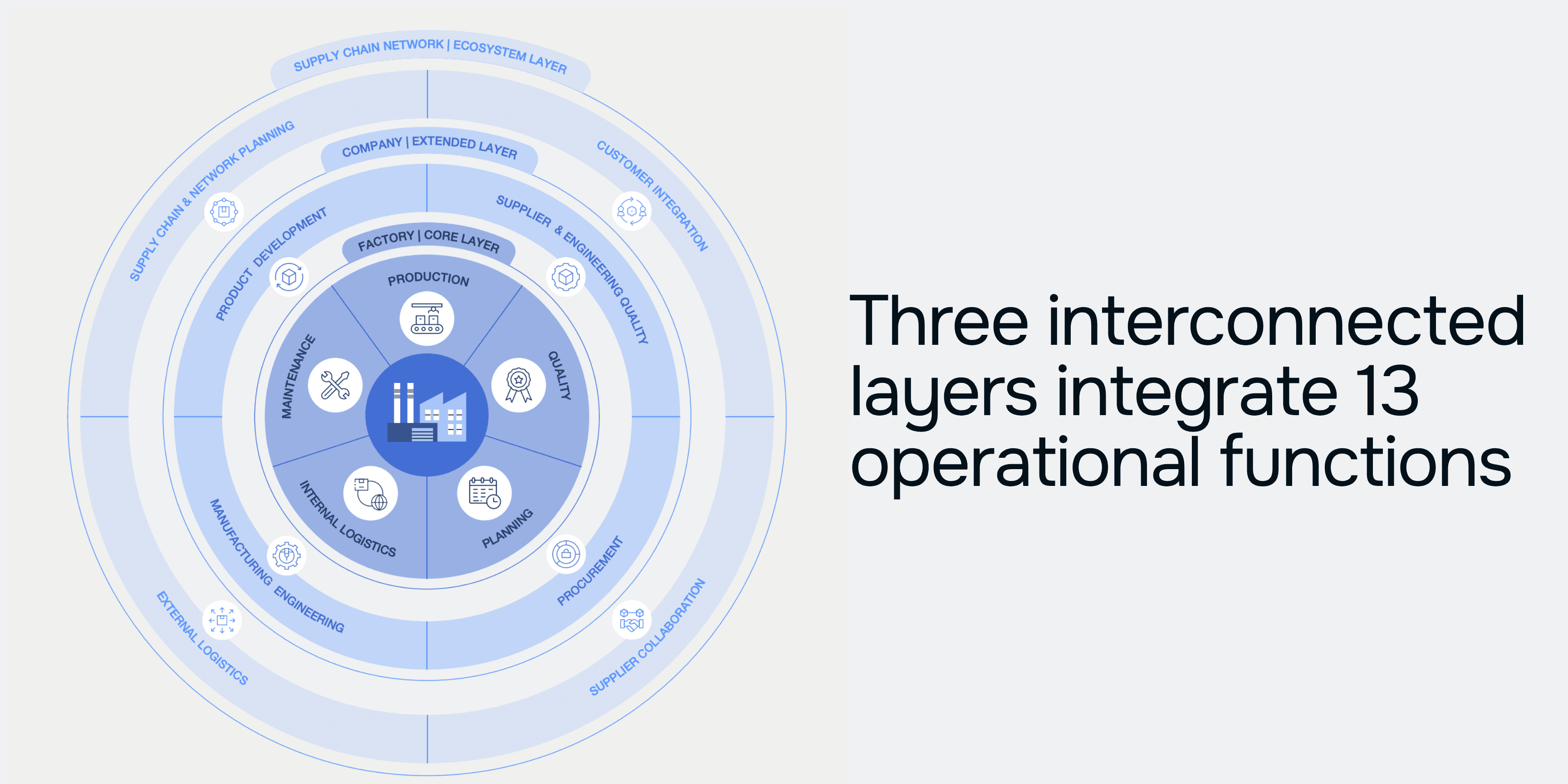
Industrial competitiveness is entering a new phase. The next edge will not come from cheaper labour or incremental automation, but from factories, supply chains and service networks that can sense, decide and adapt in real time. The World Economic Forum's latest outlook makes one point clear: AI is moving from copilots to operators. For Europe's industrial base, that shift could define the next decade.
The World Economic Forum's Intelligent Industrial Operations Outlook 2026 is the first edition of a new strategic report examining how industrial operations are evolving from traditional automation toward intelligent, connected and increasingly autonomous systems. It maps where technologies such as AI, physical AI and quantum systems are creating value across planning, production, logistics, procurement, maintenance and leadership functions. Rather than pure theory, it is built as an executive playbook using a NOW–NEAR–NEXT framework for decision-makers.
Here's 5 key takeaways:
1. AI is moving from pilot projects to full operational systems
The report argues companies are shifting beyond isolated pilots toward operating models where humans and intelligent systems work together in real time. This is a structural move: AI is no longer an innovation lab topic, but becoming part of how factories plan, produce and improve daily operations.
2. Human labour remains central — even in AI factories
Despite the autonomy narrative, more than 81% of task hours in manufacturing are expected to remain human-driven over the next few years. AI is positioned as an augmentation layer, accelerating training, knowledge transfer and decision-making rather than replacing industrial workforces outright.
3. Physical AI is arriving faster than expected
The next wave is not only software agents, but machines with autonomy. In a cited industry survey, 22% of manufacturers plan to use physical AI within two years, up from 9% today — a more than doubling in expected adoption. This includes robotic systems able to navigate production floors and perform variable tasks.
4. Supply chains are becoming autonomous risk systems
The report highlights AI agents that can monitor tariffs, weather shocks, supplier disruption and delivery risks across Tier 1 and Tier 2 suppliers, then recommend mitigation steps automatically. In an era of geopolitical fragmentation, the future supply chain may look more like a live risk engine than a procurement spreadsheet.
5. Talent is now the main bottleneck
More than one-third of 600 manufacturing executives surveyed said their top concern is equipping workers with the skills needed for smart manufacturing and advanced operations. The constraint is no longer access to software—it is access to people who can run intelligent systems at scale.

Berlin's innovation ecosystem is gathering for one of the standout moments of the calendar: the Deep Tech Award Ceremony 2026.
On 20 May 2026, founders, investors, operators, researchers and policymakers will come together at Wilhelm Studios Berlin to celebrate the companies building the next generation of industrial, scientific and software breakthroughs.
Hosted by the Senate Department for Economic Affairs, Energy and Public Enterprises, the award honours research-driven, market-ready software and hardware solutions with exceptional innovation and growth potential across five deep tech categories.

