Europe's €176 billion investment wave is coming
Five startups tackling AI's infrastructure bottlenecks, Harman's playbook for turning pilots into business, and leverage in the race for tech sovereignty.
Just weeks ago, Google announced a €13 billion investment in new AI infrastructure in Finland, including three data centres and a long-term nuclear power agreement. Meanwhile, French supercomputer maker Bull has doubled production capacity at its Angers factory as Europe pushes to expand sovereign computing infrastructure. The EU itself wants to triple data centre capacity within the next five to seven years and has launched its AI Gigafactory push to mobilize more than €30 billion in public and private investment.
Overall, investment in data centres is projected to reach €176 billion between 2026 and 2031.
But adding GPUs is only part of the challenge. Those machines need electricity, cooling and high-speed connections – precisely the layers where bottlenecks are now emerging. That is why this issue’s Top 5 looks at five early-stage European startups building the physical infrastructure behind AI, from advanced liquid cooling and metal foams to optical interconnects and next-generation data centre networking.
In our interview, Jens Kronen of Harman International explains what it actually takes for a deep tech startup to turn a pilot with a global industrial player into real business. His core advice: understand the factory, solve a measurable problem and prove that your technology can scale.
Also in this issue:
- The Leap: Europe should pursue technological sovereignty not through autarky, DTM’s CEO Martin Schilling argues, but by owning critical technological chokepoints. This goes from semiconductors and quantum to fusion and industrial AI. He believes that this is what leaves us with strategic leverage and makes others depend on Europe.
- The Pulse: Five takeaways on Europe’s data centre boom – and why electricity may become its biggest constraint.
Let’s dive in.
Dear all,
At the beginning of the 20th century, Germany had a problem it didn't like to talk about. Its farms and arsenals ran on nitrate from Chile, shipped across oceans controlled by the Royal Navy. One blockade, and the country would run out of fertiliser and explosives at once.
In 1908, Fritz Haber, a Karlsruhe professor, told BASF he could pull nitrogen out of thin air. BASF signed.
On 2 July 1909, BASF sent its team to Karlsruhe for the proof. A bolt failed, and Carl Bosch, the man BASF was counting on, had to leave early. When the machine finally ran, nothing happened. Then drops began to form. Ammonia.
Bosch got the job of turning a tabletop machine into a factory. His first steel reactors burst, eaten from the inside by hot hydrogen. He redesigned them and kept going.
It took four years and an enormous investment. But in September 1913, the Oppau plant began producing ammonia, without a single shipload of Chilean saltpetre.
Eleven months later, war broke out. By autumn 1914, the blockade had cut off Chile. Without synthetic nitrogen, Germany would most likely have faced a nitrogen crisis by autumn 1915.
This is not a heroic story; the process prolonged a terrible war. But it is a clear lesson about technological leverage.
A century later, Europe faces the same question. Only the cargo has changed: chips, cloud capacity, AI models, rare earths.
Over the past weeks, I have had a series of conversations with senior corporate leaders about exactly this: should technological sovereignty be a goal for Europe at all? Several CEOs of global companies told me they avoid the word entirely. Their business depends on being welcome in every region of the world.
Two models usually dominate the debate.
The first is autarky: build the full stack in Europe, from chips to clouds to models. It sounds decisive. It is also unaffordable, slow, and an invitation to retaliation.
The second is alliance. Mathias Döpfner, CEO of Axel Springer, put it bluntly this summer: "I absolutely don't believe in the idea of European sovereignty when it comes to tech." For him, the only question is who our allies are. The weakness: allies own chokepoints too, and they use them.
There is a third model. Sovereignty is not owning everything. It is owning enough that others cannot do without you. Leverage.
Leverage means owning the chokepoints others depend on.
Where Europe Can Build Leverage
Semiconductors. None of the world's most advanced chips is made at scale without ASML, Zeiss optics and Trumpf, the sole maker of the lasers that drive EUV machines. ASM International holds more than half the market for atomic layer deposition, which deposits films one atomic layer at a time. Infineon is the clear number one in power semiconductors, a gateway to the power supply of AI data centres.
Quantum. Delft-based QuantWare has shipped quantum processors to more than 50 customers in 20 countries, which it says makes it the largest commercial supplier by volume. Finland's Bluefors leads in the refrigerators that keep superconducting quantum computers near absolute zero.
Fusion. Proxima Fusion raised €411 million to build its Alpha stellarator near Munich. The real chokepoint is superconducting (HTS) tape, made mostly in Asia. Proxima needs around 60,000 kilometres of it, so it is planning Europe's first large-scale factory in Lower Saxony.
Industrial AI and robotics. Siemens is building an industrial foundation model on 150 petabytes of product data and patents. Over 1,000 automotive companies exchange data through Catena-X. And Schaeffler says actuators, the drives that move a robot's joints, account for around half of a humanoid's cost. It has signed deals to supply them to Neura Robotics and London-based Humanoid.
Three Questions
Hermann Hauser, co-founder of Acorn Computers, the company that gave birth to Arm, offers the simplest test I know. For every critical technology, ask:
- Do we control it in our own country?
- Can we access it from multiple independent countries?
- Do we have long-term, guaranteed, unfettered and secure access from a monopoly or oligopoly supplier in a single country?
If the answer to all three is no, Hermann says, you have to change something. His warning is about a new kind of colonialism, enforced not by armies but by economic dependence.
With wishes that Europe stops asking who our allies are, and starts making sure everyone else has to ask about us.
Martin
Source: Harman
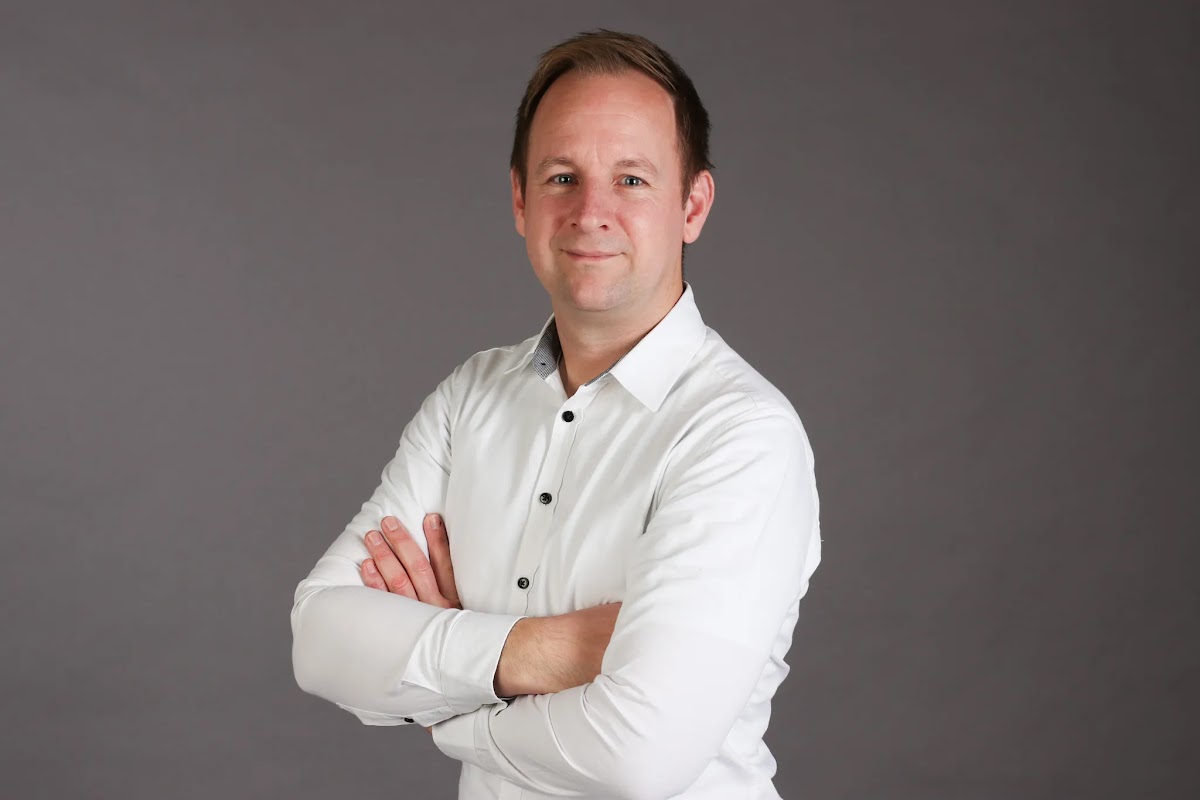
Jens Kronen is Senior Technology Scouting with Harman International. He has more than a decade of experience at the intersection of emerging technologies, corporate innovation and the automotive industry. A graduate in Computer Engineering from Hochschule Niederrhein, he previously worked in open innovation at Hyundai Cradle before joining Harman International, a subsidiary of Samsung Electronics. Harman International develops connected technologies and solutions for the automotive industry, consumer electronics and professional audio, including brands such as JBL, Harman Kardon and AKG.
As Senior Technology Scouting and Partnership Manager at Harman International, which deep tech fields are you actively scouting right now?
My focus is less on a specific technology category and more on identifying technologies that can create strategic differentiation for our automotive customers over the next years. Right now, that includes AI-native user experiences, software-defined vehicle technologies, multimodal HMI, digital cockpit innovations, connected vehicle platforms, advanced sensing, and next-generation audio experiences. What interests me most are technologies that are technically mature enough to be integrated into automotive products while still providing a meaningful competitive advantage.
What helps a startup move from an initial pilot to a real commercial partnership with Harman?
A successful pilot is only the beginning. What ultimately matters is whether the startup can demonstrate measurable business value, integrate into existing product roadmaps, and meet the quality, security, and scalability requirements expected in the automotive industry. The startups that succeed are those that stay closely aligned with internal stakeholders throughout the pilot, respond quickly to feedback, and continuously adapt their solution. They also understand that commercial success depends on solving a real business problem, not just proving that the technology works. In my experience, strong internal champions on both sides are just as important as the technology itself.
What's your top advice to a founder trying to work with a company at Harman's scale?
Don't start by pitching your technology, start by understanding the customer's problem. Large organizations evaluate innovation through the lens of business impact, risk, and execution. Founders who understand those dimensions stand out immediately. Be clear about the value you create, be realistic about your product's maturity, and make it as easy as possible for the customer to evaluate and integrate your solution. Finally, be patient but proactive. Enterprise partnerships take time, but consistent communication, transparency, and reliability build trust much faster than oversized promises.
Europe’s AI ambitions depend on more than computing power. Here are five early-stage companies addressing different parts of that challenge by developing the physical infrastructure needed to make AI data centres faster, more energy-efficient and scalable.
Apheros | Baden, Switzerland
- Technology: Patented metal-foam technology with exceptionally high surface area and open porosity, designed to improve heat transfer in liquid-cooling systems. Its metal foams can be integrated into existing cooling architectures, including cold plates for high-performance processors.
- Customers & Partners: Targeting data centre operators, cooling-system manufacturers and high-performance computing infrastructure providers. Its investors include Founderful; individual commercial customers have not been publicly confirmed.
- Use cases: Direct liquid cooling for AI servers, high-density computing infrastructure, power electronics and other applications requiring efficient thermal management.
- Funding: $1.85M Pre-Seed financing in August 2024, led by Founderful. The company subsequently opened a CHF 8M Seed round in November 2025, although its closing has not been publicly confirmed.
- Why it matters: As AI processors become more powerful, heat removal is emerging as a fundamental constraint on computing density. Apheros is developing advanced materials that could improve cooling performance without requiring data centres to replace their entire thermal-management infrastructure.
→ In 2025, Apheros scaled its proprietary manufacturing process to a pilot plant with capacity equivalent to more than 20,000 cold plates per year.
Aylight | Zurich, Switzerland
- Technology: Chip-scale multiwavelength lasers based on optical frequency-comb technology. A single semiconductor laser generates multiple precisely spaced wavelengths, potentially replacing arrays of individual lasers used in optical communication systems.
- Customers & Partners: Targeting manufacturers of optical transceivers, photonic components and AI data centre networking equipment. The company is transitioning from academic research to its first semiconductor-foundry prototypes; commercial customers have not yet been publicly disclosed.
- Use cases: High-bandwidth optical interconnects between AI processors, data centre networking, high-precision sensing, semiconductor inspection and industrial metrology.
- Funding: €4.5M Pre-Seed financing in July 2026, co-led by Elaia and Swisscom Ventures, with participation from Verve Ventures and Plug and Play.
- Why it matters: The expansion of AI clusters is creating an increasingly difficult challenge: moving enormous volumes of data between processors without a proportional increase in energy consumption. Aylight is developing a fundamental component of optical communication infrastructure that could reduce the number of lasers required to connect future AI systems.
→ Founded in 2025 following research at ETH Zürich, Aylight is using its first financing round to move its laser architecture from the laboratory into semiconductor-foundry prototypes.
Astrape Networks | Eindhoven, Netherlands
- Technology: Hybrid optical-electronic networking infrastructure that dynamically adapts data transmission paths to changing workloads. Its EFFINITI architecture combines optical switching with conventional Ethernet to reduce network congestion, latency and unnecessary electrical-optical conversions.
- Customers & Partners: Targeting hyperscale data centre operators, AI infrastructure providers and high-performance computing facilities. Its publicly disclosed ecosystem includes PhotonDelta, PhotonVentures and the European Innovation Council.
- Use cases: AI cluster interconnects, high-performance computing networks, data centre traffic optimization and energy-efficient communication between large numbers of GPUs.
- Funding: €7.9M Seed financing in April 2025, including a €2.5M European Innovation Council grant. The round was co-led by PhotonVentures, Join Capital and Brabant Development Agency (BOM), with participation from Shift Invest.
- Why it matters: Network congestion limits AI cluster performance and wastes energy. Astrape’s European networking architecture aims to improve processor utilization while reducing energy consumption across data centres.
→ Astrape’s Belgian demonstration centre showcases EFFINITI, which the company claims can cut network energy consumption by over 70% and double accelerator utilization.
MegaCool Technologies | Leuven, Belgium
- Technology: Direct-to-chip liquid-cooling systems built around proprietary, generatively designed cold plates. Its SmartFins technology optimizes coolant flow and heat transfer according to the thermal characteristics of individual processors, supported by a digital simulation platform.
- Customers & Partners: Targeting AI data centre operators, server manufacturers and high-performance computing infrastructure providers. Vsquared Ventures is a reported investor; individual commercial customers have not been publicly confirmed.
- Use cases: Liquid cooling for high-density GPU clusters, AI training infrastructure, high-performance computing and thermal management for next-generation processors.
- Funding: $5.9M Seed financing reported in February 2026, with Vsquared Ventures as a lead investor.
- Why it matters: Rising processor power densities are making conventional cooling architectures increasingly difficult to scale. MegaCool is developing cooling hardware that can be integrated into existing data centre infrastructure while addressing the thermal requirements of future AI processors.
→ MegaCool reports that its SmartFins architecture reduces thermal resistance by 30–50% compared with conventional solutions. Its simulation-driven development process targets four-week prototyping cycles.
Solinide Photonics | Gothenburg, Sweden
- Technology: Silicon-nitride photonic integrated circuits and proprietary microcomb technology that generate multiple optical wavelengths from a single laser source. Its architecture is designed to provide high-bandwidth optical communication with lower power consumption and fewer individual laser components.
- Customers & Partners: Targeting photonics and optical-networking companies, semiconductor developers and AI infrastructure providers. The company reports a partnership with NVIDIA, although the commercial scope of the relationship has not been independently established.
- Use cases: Optical interconnects for AI data centres, co-packaged optics, hyperscale computing, telecommunications networks and high-performance computing.
- Funding: €4M Seed financing in August 2026, co-led by Navigare Ventures and PSV Hafnium, with participation from Chalmers Ventures, Turbine Capital, Norrsken Evolve and Almi Greentech Fund.
- Why it matters: Solinide’s photonic technology aims to reduce the energy consumption, cost and footprint of optical communication in AI infrastructure.
→ In August 2026, Solinide launched LumiCOMB, a Swedish-made optical frequency-comb generator featuring 28 wavelength channels and over 60% conversion efficiency.
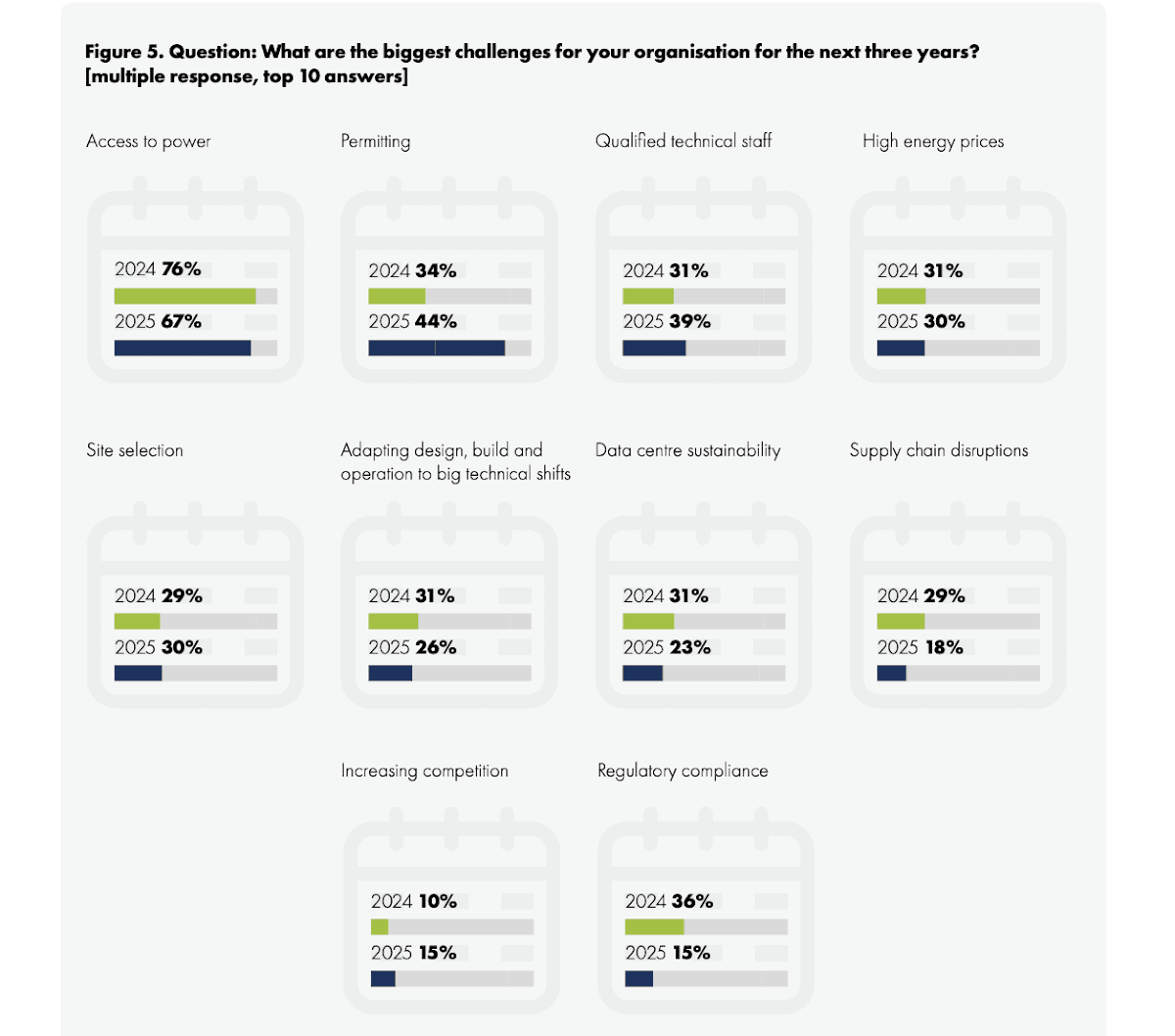
Power is Europe's biggest data centre bottleneck: 67% of operators cite electricity access as their greatest challenge, followed by permitting (44%) and skilled labour (39%). Source: EUDCA, State of European Data Centres 2026.
Europe is entering an unprecedented data centre expansion. But the biggest obstacle is no longer investment or demand. It is access to electricity.
The new State of European Data Centres 2026 report by the European Data Centre Association (EUDCA), conducted by Pb7 Research, reveals how AI is transforming Europe’s digital infrastructure. Drawing on market data, industry forecasts and a survey of 69 data centre decision-makers, the study examines investment, energy constraints, emerging technology and the shifting geography of European computing infrastructure.
Here are five key takeaways:
1. Europe is heading for a €176 billion investment wave. Cumulative data centre investment is projected to reach €176 billion between 2026 and 2031, driven by cloud expansion, AI workloads and demand for sovereign digital infrastructure.
2. Electricity is becoming the biggest bottleneck. 67% of surveyed operators identify access to power as their greatest challenge. European IT power demand is projected to grow by 17% annually through 2031, putting additional pressure on already constrained electricity grids.
3. AI is forcing a fundamental rethink of cooling. While traditional server racks typically consume 8–12 kW, AI clusters frequently require 30–80 kW per rack. This is accelerating the transition towards liquid cooling, direct-to-chip technologies and advanced thermal management.
4. Europe's data centre map is shifting. Established hubs such as Frankfurt, London and Amsterdam face increasing power constraints. Meanwhile, the Nordics, Southern Europe and emerging metropolitan regions are attracting investment through renewable energy availability, connectivity and available land.
5. Data centres are becoming major economic infrastructure. The report projects that Europe's colocation sector alone could contribute €137.5 billion to GDP annually by 2031, up from €53 billion in 2025. However, realizing this growth will depend on grid expansion, faster permitting and more efficient infrastructure.
Four upcoming events bringing together founders, investors, corporates and policymakers shaping Europe's technological future.
Deep Tech Summit 2026 | Warsaw, Poland
26–27 October 2026
Bringing together over 1,000 participants from 30+ countries, including 250+ startups and 150+ investors. The summit connects Central and Eastern Europe's deep tech ecosystem with international capital through curated matchmaking, investor meetings and corporate partnerships.
Industrial Future Summit 2026 | Stockholm, Sweden
9–10 November 2026
A curated gathering where Europe's industrial leaders and founders meet to set the direction for the next decade of industrial transformation, from physical AI and robotics to scaling AI into real business value. Speakers include Ola Källenius (CEO, Mercedes-Benz Group), Micael Johansson (CEO, Saab) and Tanuja Randery (Managing Director EMEA, AWS). Built for industrial decision-makers, founders and investors building the next era of European industry.
Horizon Deep Tech Summit 2026 | Madrid, Spain
10–12 November 2026
A three-day gathering connecting research-driven startups, investors and industrial leaders. Supported by the European Commission and featuring the EIC Tech to Market Programme, the summit focuses on commercializing breakthrough research and building strategic partnerships across Europe's deep tech ecosystem.
Slush 2026 | Helsinki, Finland
18–19 November 2026
One of Europe's major founder-investor gatherings, bringing startups and international venture capital together in Helsinki. Two days of investor matchmaking, startup showcases and discussions on scaling technology companies, with opportunities for European deep tech founders seeking international capital.

