Europe's Biggest Bets in Physical AI & Manufacturing
Where €2 billion in European physical AI funding is going, five robotics startups to watch, and what Audi and the EIF reveal about scaling deep tech.

Getting robots to work reliably in the real world seems harder than attracting capital for them, as The Wall Street Journal reported last week: Walmart's started a multibillion-dollar warehouse automation push, but even seemingly simple tasks such as sorting individual items remain difficult for robots to master.
This week, we spotlight five early-stage European warehouse and logistics robotics startups worth watching. From autonomous picking and robot orchestration to humanoid deployment and container-terminal automation, these venture-backed companies are finding new ways to make robotics commercially viable, often without rebuilding existing infrastructure.
Also: As we curate the House of Physical AI & Manufacturing for DTM27, we are listening closely to Europe's industrial customers. We identified ten recurring problems and matched them against 100 European venture rounds of €5 million or more since January 2024. The finding is striking: five immediately measurable challenges attracted €1.5 billion across 50 rounds, while five equally critical but less visible problems, including robot components, production data and safety certification, received just €550 million across 22 rounds. Are investors funding the problems industry can price today, while overlooking the technologies that will determine who owns tomorrow's industrial value chains? That's the question Martin Schilling explores today.
Also in this issue:
- Europe's capital gap: The latest EIF Equity Survey reveals why insufficient growth capital and weak exit markets continue to threaten Europe's ability to scale and retain its next generation of technology champions.
- Venture Clienting at Audi: Jeenal Chandra of Audi Startup Connect explains what founders need to turn promising pilots into lasting OEM partnerships, and why execution, industrial readiness and understanding legacy systems matter as much as breakthrough technology.
Let's get into it.
Dear all,
Together with the DTM team, I am currently curating the House of Physical AI & Manufacturing for DTM27. That means I have the pleasure of listening to many of Europe's industry customers these days. Here are the ten problems that come up again and again.
We matched them against 100 verified European venture rounds of €5 million or more in physical AI and manufacturing since January 2024. Below are the five problems where startups and investors hear industry customers well, and the five where industry customers are not heard enough.
Where industry customers are heard
Industry customer problem | Example industry customers | Funding | Startups funded |
Engineering speed Car makers, aerospace and machine builders lose years and millions per programme because every design change needs a physical prototype. | Airbus, BMW, Renault, Volvo Cars | 370 (9) | PhysicsX, Neural Concept, Synera |
Warehouse throughput at peak Logistics operators must hold peak volumes with warehouse staff they cannot recruit, and pay for peak capacity all year. | DHL, DSV, Zalando, Ocado | 343 (11) | Sereact, Dexory, Nomagic |
Precision-parts supply OEMs and primes wait months for machined, printed and electronic parts, because Europe's tier-2 and tier-3 suppliers are shrinking and new ones take too long to qualify. | Airbus, KNDS France, Thales | 334 (16) | Isembard, Alloyed, CloudNC |
Unstaffable manual stations Plants cannot staff stations built for people, and rebuilding them for classic automation costs more than the labour saved. | BMW, Renault, Mercedes-Benz, Airbus | 268 (3) | Humanoid, Generative Bionics, Wandercraft |
Plant cost at low utilisation Car makers and suppliers must cut cost in plants running at about 60% utilisation, because European volumes fell and Chinese competitors reset the cost base. | Stellantis, Volkswagen | 171 (11) | Pelico, SPREAD AI, EthonAI |
Where industry customers are not heard enough
Industry customer problem | Example industry customers | Funding | Startups funded |
High-mix, low-volume automation Mid-sized manufacturers running batches of thirty cannot automate, because programming and changeover cost more than the robot saves and they have no automation team. | Zalando, Mössner, Siemens Amberg | 243 (7) | RobCo, THEKER, coboworx |
Production data to AI at scale Manufacturers collect production data they cannot turn into decisions, so AI stays stuck in pilots and never reaches the line. | Unilever, Schneider Electric, Siemens | 190 (7) | Encord, microagi, Robovision |
Robot component supply Component makers losing combustion volume want to supply actuators, hands and motors to robot makers, but that supply base is being built in China. | Schaeffler, SCHUNK, SKF | 61 (4) | Additive Drives, Alva, Mimic |
Recycled-content compliance Packaging, consumer-goods and battery makers must meet EU recycled-content and recovery targets, but sorting and battery disassembly are still largely manual. | Unilever, Danone | 48 (3) | Greyparrot, R3 Robotics, WeSort.AI |
Safety certification of learning machines From 20 January 2027, machine builders cannot sell a machine whose safety relies on machine learning without a notified-body certificate, and few tools exist to produce the proof. | Every machine builder selling in the EU; certifiers preparing: TÜV SÜD, DTI/Dancert | 5 (1) | Sonair, the only one |
Split based on DTM's assessment of how widespread each problem is in its Guardians of European Deep Tech network, compared with funding.
What do we learn?
Money follows problems a CFO can price. Prototype weeks, peak wages, parts delays and cost per car all sit in this year’s budget. Those five problems drew €1.5 billion in 50 rounds. Data, safety proof, robot components, recycling and small-batch automation pay off later or across departments. They drew €0.55 billion in 22, almost three times less.
The problems that decide whether robots reach the line are the hardest to sell. European actuators, hands and motors drew €61 million. Certified safety drew one round of €5 million, three months before it becomes mandatory.
The biggest bets build on the problems funded least. NEURA has announced a Series C of up to $1.4 billion. AMI Labs raised about $1 billion for world models. Every one of those machines will need certified safety, factory data and a European supply of actuators. Europe built KUKA, then sold it. If we leave the unheard five to others, we will build the platform and own none of what it runs on.
Help us build the House of Physical AI & Manufacturing
We are building the House of Physical AI & Manufacturing to put industry customers, founders and investors in one room.
Industry customers: Send us the one problem you would pay to solve in 2027. Did you solve one on a real line? Tell us the story you would share on the DTM stage.
Innovators, from startups, SMEs and research labs: Send us the industry customer you need in the room, and the problem you would solve for them. Do you have a deployment with impact numbers? Suggest a DTM stage session with that customer.
Investors: Send us the unheard problem you would back, and the industry customers you want to meet. Do you have a thesis on it? Tell us which theme you could talk about on the DTM stage.
Write to martin.schilling@deeptech.build and we will answer your call.
To physical AI and manufacturing tech as Europe's unfair advantage,
Martin

Source: Audi
Jeenal Chandra is part of Audi Startup Connect, where he drives startup scouting, venture clienting and the integration of emerging technologies into Audi’s innovation ecosystem, building on a background in automotive engineering and technology innovation.
As Venture Clienting Lead at Audi, which deep tech fields are you actively seeking startup collaborations in right now?
I am part of a broader Venture Clienting team at Audi that covers multiple domains. My focus is on the product, the car, and as you can imagine, it comes with confidentiality requirements that prevent me from revealing exact areas of focus. In general, I am interested in any technology in any field that would provide genuine value to our customers. The customer can be company internal customers or external car-buyers in this case. It is obviously exciting and a privilege to be on the look out for the next big innovation but, at the same time, I see great value in Venture Clienting in improving legacy systems as well. The most amazing thing about working in the automotive industry is the bandwidth of topics that I get to cover. From AI to tires, from lighting to composites, there are a multitude of areas where Venture Clienting can have an impact here at Audi.
What helps a startup move from a first pilot to a real commercial partnership with Audi?
Success of the pilot in terms of results and execution is obviously a deciding factor. This sounds straightforward, but you'd be surprised how often startups ignore the execution part. The advice here is to only take on projects where you can fully commit the necessary resources to execute satisfactorily. As a startup there's inherent pressure to cover as many projects with as many customers as possible, but from experience, the chances of success are much higher by carefully selecting projects and committing fully to them. A good idea carefully executed is sometimes better than a great idea badly executed. In the automotive field, a pilot is more than just a proof of technology, because cars have long lifecycles from product development to end-of-life, it's also a feasibility check of a long-term partnership, and a proof of reliability, dependability, flexibility, and cultural fit. Then there's the commercial readiness part: how well the startup and its product are prepared, and how well the requirements of a commercial partnership are met, plays an important role. For example, to supply certain products in the automotive industry, certifications like ISO norms, IT-security standards, or product testing standards are required. Thinking about these early and planning for them makes onboarding and commercial contracting much easier.
What's your top advice to a founder trying to sell into an OEM at Audi's scale through venture clienting?
Every target industry has its own product integration requirements and established commercial working models, automotive, defense, hyperscalers, SaaS platforms all have their own requirements. I see too often startups with really good technologies that come to us without any thought put into a go-to-market plan. My advice, on top of striving to create a product that adds genuine value to customers, is to inform yourself about the technical and commercial needs of your target industry from the very beginning, and where possible build those into the product design early so there are fewer hurdles later. For example, a startup product designed for integration into Audi vehicles needs to consider safety, security, thermal, mechanical, electromagnetic, and emissions-related requirements from the start, some of which can be extremely difficult to retrofit. Understanding these early and designing for them significantly reduces time-to-market. Scale matters too: having an industrialization plan, along with diagnosis, repair, and customer support plans for a product lifecycle of up to 15 years, massively improves the chances of success. In short: don't just develop a good product, complement it with a good plan.
Warehouse automation is entering a new phase. Across Europe, a new generation of venture-backed startups is making robotics more adaptable, affordable and commercially viable, from autonomous picking and intelligent intralogistics to humanoid deployment and automated container terminals.
Here are five early-stage companies worth watching.
NEOintralogistics | Düsseldorf, Germany
- Technology: Autonomous mobile robots (AMRs) combined with proprietary orchestration software and a Robotics-as-a-Service model. NEO's system converts existing shelving warehouses into automated goods-to-person operations without requiring structural modifications. Its robots retrieve containers directly from storage racks and deliver them to picking stations, while the NEO platform coordinates workflows and integrates with existing warehouse management systems.
- Customers & Partners: Early customers include Conrad Electronic and Versandmanufaktur, part of the GLS Group. Investors include Amadeus APEX Technology Fund and Cetus Holding.
- Use cases: Automated order picking, e-commerce fulfilment, spare-parts logistics and warehouse retrofitting. Particularly relevant for operators seeking to automate existing facilities without major capital expenditure.
- Funding: Raised €3M in Seed funding in January 2026, co-led by Amadeus APEX Technology Fund and Cetus Holding. The investment supports product development, customer acquisition and international expansion.
- Why it matters: Traditional warehouse automation often requires substantial upfront investments and infrastructure modifications, limiting adoption among smaller operators. NEO addresses both barriers through a pay-per-pick model that turns automation into an operating expense. Its approach could make robotic fulfilment economically viable for a significantly broader segment of Europe's logistics industry.
→ NEO says its system can reduce picking labour requirements by up to 70%, increase storage capacity by two to three times and become operational within just six to eight weeks, without rebuilding existing warehouses.
Logibot | Zellik, Belgium
- Technology: Hardware-agnostic AI software designed to select, train, deploy and orchestrate robots from different manufacturers. Its platform analyses warehouse workflows, simulates automation scenarios through digital twins and integrates third-party robotic systems into existing operations. Remote human supervision provides additional operational flexibility.
- Customers & Partners: Target customers include postal operators, parcel delivery companies, third-party logistics providers and industrial warehouse operators. Early deployments include a major Nordic postal and logistics group operating a robot in Denmark. Investors include BeamBerlin, RDY Ventures, PMV and finance&invest.brussels.
- Use cases: Parcel sorting, warehouse material handling, loading-dock replenishment, robotic fleet integration and automation of repetitive logistics tasks.
- Funding: Secured €1.4M in Seed funding in September 2026, led by BeamBerlin, the venture studio associated with intralogistics group BEUMER. Additional investors include RDY Ventures, PMV, finance&invest.brussels and business angels. The funding supports initial commercial deployments and platform development.
- Why it matters: As robotic hardware becomes increasingly available, integration and interoperability are emerging as critical bottlenecks. Logibot addresses this challenge by separating the intelligence and deployment layer from individual hardware manufacturers. Its approach could enable warehouse operators to adopt different robotic systems without becoming dependent on a single supplier.
→ Logibot claims its platform is compatible with approximately 95% of commercially available robot hardware. Its ambition is to make robotic labour as flexible to deploy as temporary warehouse staff.
Levtek | Malmö, Sweden
- Technology: AI-powered ride-on robotic mobility platforms designed to transport people, tools and goods across logistics and industrial environments. Its Levkart vehicles combine immediate human-operated functionality with the gradual development of autonomous capabilities, using real-world operational data to train and improve robotic intelligence.
- Customers & Partners: Early customers and deployment partners include IKEA, PostNord and European micromobility company Voi. Venture backers include ellipsis Ventures and FOV Ventures.
- Use cases: Internal material transport, warehouse mobility, logistics terminal operations, industrial intralogistics and repetitive transportation tasks across existing facilities.
- Funding: Raised an oversubscribed Pre-Seed round backed by ellipsis Ventures and FOV Ventures. The funding amount has not been publicly disclosed.
- Why it matters: Many autonomous robotics companies face a difficult commercial dilemma: developing full autonomy requires substantial real-world data, but collecting that data often depends on deployment. Levtek reverses this sequence. Its vehicles generate operational value from day one while progressively acquiring the data needed for autonomous operation, creating a potentially more capital-efficient path toward scalable robotics.
→ Levtek moved from pilots to production deployments in 2026. Its Levkart robots are operating at Voi's central European warehouse in Poznań and at PostNord's Danish logistics terminals in Brøndby and Herning.
Motion | Belgium
- Technology: Humanoids-as-a-Service platform that integrates commercially available humanoid robots into industrial operations. Motion combines robot selection, task-specific AI training, workflow integration, deployment and fleet management into a managed service, allowing industrial customers to adopt humanoid robotics without developing the necessary technical infrastructure internally.
- Customers & Partners: Industrial manufacturers, warehouse operators and logistics companies. Motion has announced five live pilot projects in Belgium, targeting repetitive industrial tasks. Investors include Extantia Capital and Norrsken Evolve.
- Use cases: Warehouse material handling, packaging, repetitive production-line activities, loading operations and industrial tasks designed around human workers.
- Funding: Raised $2M in Pre-Seed funding in August 2026, led by Extantia Capital with participation from Norrsken Evolve. The investment supports converting five pilot projects into production deployments, expanding the robotic fleet and scaling operations across the Benelux region.
- Why it matters: Humanoid robotics promises automation without redesigning industrial facilities, but reliable deployment remains technically and operationally demanding. Motion is building the integration and service infrastructure required to make humanoids commercially useful. Rather than competing directly with robot manufacturers, it aims to capture value from deploying, operating and maintaining robotic labour in real industrial environments.
→ Motion was founded by Alexander Stevens, who previously built and exited sustainability software company Greenomy in 2025. His new venture is tackling a very different problem: making humanoid robots productive on European factory floors.
Seal Robotics | Munich, Germany
- Technology: Modular robotic systems designed to automate safety-critical and physically demanding operations in container terminals. Combining robotic manipulation, computer vision, sensing and autonomous mobility, Seal develops solutions for container twistlock handling, pin operations on railway wagons and hazardous-environment inspection.
- Customers & Partners: Target customers include seaports, inland terminals, intermodal logistics operators and rail freight infrastructure providers. The company is expanding pilot projects internationally. Investors include Creator Fund, Auxxo, January Ventures and Marvelous.
- Use cases: Automated container locking and unlocking, railway wagon pin handling, gas inspections, terminal safety operations and repetitive container-handling processes.
- Funding: Closed a €1.8M Pre-Seed round in February 2026, led by Creator Fund with participation from Auxxo, January Ventures, Marvelous and angel investor Stefan Tietze. The investment supports product development, international pilot projects and commercial deployment.
- Why it matters: Container logistics remains dependent on manual intervention for several safety-critical processes, despite decades of investment in port automation. Seal Robotics focuses on specialised tasks that are difficult to automate using conventional industrial systems. By targeting these operational bottlenecks, the company could improve terminal safety, reliability and throughput without requiring full infrastructure replacement.
→ Seal's CTO, Daniel Leidner, spent approximately 15 years developing space robotics at the German Aerospace Center (DLR). The company is now applying expertise originally developed for robots operating in space to some of the toughest working environments on Earth: container ports.
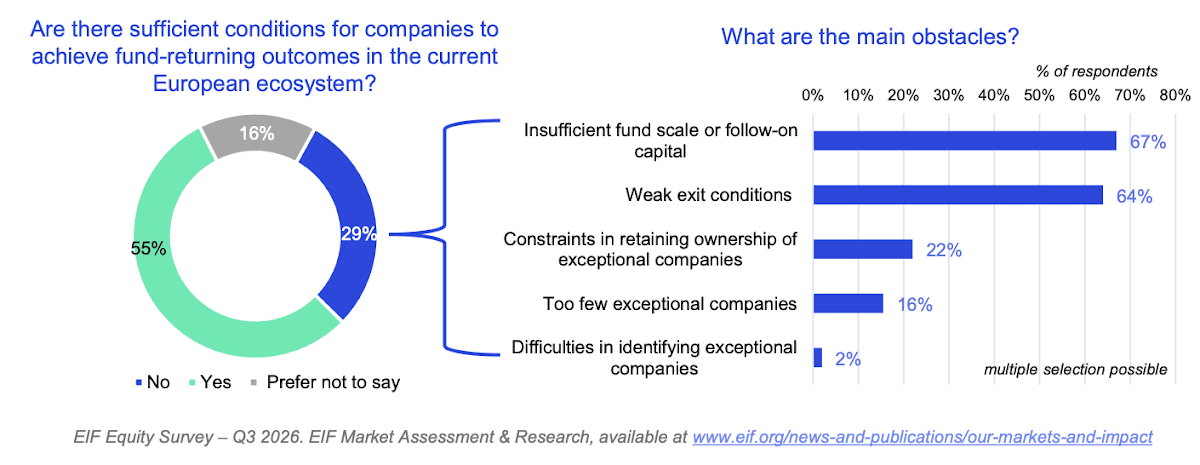
67% cite insufficient growth capital. 64% point to weak exit markets. Europe's scaling challenge, captured in the latest EIF Equity Survey. Source: EIF Equity Survey Q3 2026.
Europe's venture capital market is recovering. But the money is increasingly flowing to fewer funds, fewer sectors, and fewer companies.
Published on October 15, the EIF Equity Survey Q3 2026, conducted by the European Investment Fund with support from Invest Europe, captures insights from 682 venture capital and private equity fund managers. The report examines fundraising, investment activity, exits, and the conditions shaping Europe's next generation of global technology champions.
Here are five key takeaways:
01 | More capital. Fewer winners.
European VC fundraising is recovering, but capital is increasingly concentrated among established fund managers and later-stage investors. Smaller funds and early-stage VCs continue to struggle.
02 | Deep tech is gaining momentum.
Despite declining investor sentiment, deal flow remains resilient. AI, deep tech, space tech, and defence tech are attracting significant investment, reinforcing their strategic importance in Europe's innovation economy.
03 | Fundraising remains the biggest bottleneck.
Investor sentiment on current fundraising conditions stands at -46% net, highlighting the persistent difficulties fund managers face in securing fresh capital. Europe's investment pipeline is stronger than its ability to finance it.
04 | Europe creates champions. But struggles to retain them.
Almost one-third of Europe's most successful fund-returning companies are now headquartered in the US, compared with just 8% when founded. Limited growth financing and exit opportunities are putting Europe's long-term technological competitiveness at risk.
05 | The biggest winners are almost impossible to predict.
Only 11% of surveyed fund managers reported an investment that generated at least the entire value of a fund. Among those with such investments, just 1% initially identified their biggest winner as their most promising investment. A powerful argument for diversified early-stage investing.
Two events. Two opportunities to connect breakthrough technologies with capital, industry and strategic partners. These upcoming events bring together founders, investors, corporates and policymakers shaping Europe's technological future.
October 26-27 | Warsaw, Poland
Focus: AI · Defence & Dual Use · Energy · Space · Advanced Manufacturing
1,000+ attendees. 250+ startups. 150+ investors.
Central and Eastern Europe's deep-tech ecosystem comes together for two days of investment matchmaking, technology showcases and strategic discussions.
Combining Investment Day, VC Central and the Deep Tech Summit, the event connects emerging technology companies with international investors, corporate decision-makers and research institutions.
Why attend: A valuable gateway to Central and Eastern Europe's growing deep-tech ecosystem, particularly for investors looking for new deal flow and founders seeking cross-border partnerships.
November 2-3 | Essen, Germany
Focus: Clean Energy · Industrial Decarbonisation · Energy Storage · Smart Grids · Mobility
60+ selected companies. 140+ investors. 250+ one-to-one meetings.
A highly curated investment forum connecting Europe's emerging energy technology companies with venture capital, corporate investors and industry leaders.
The programme spans next-generation energy systems, industrial decarbonisation, hydrogen, energy storage, power grids and clean transportation.
Why attend: Particularly relevant for climate and energy deep-tech founders raising capital, investors evaluating emerging technologies, and industrial corporates searching for scalable decarbonisation solutions.

