New Energy: Wind and solar won't be enough
Europe's next-generation renewables, dena's Pia Dorfinger on what founders get wrong, seven deep tech revenue models that scale, and the EU's scale-up gap.
Europe’s energy transition is getting more interesting again.
Reuters reported last week that the Iberian Peninsula’s share of European data-centre capacity is expected to almost double by 2030. The data-centre boom in Spain and Portugal is triggering a new wave of investment in renewables, storage and hybrid power systems. That’s a snapshot of a bigger shift: Europe’s energy challenge is no longer simply about adding more wind and solar. A broader generation stack needs to deliver clean energy more predictably, in more places and for more demanding loads.
That is where things get interesting. Wave power, deep geothermal, solar fuels, tidal systems and airborne wind are moving from technical demonstration toward commercial deployment. In our conversation with Pia Dorfinger, Director for Start-ups & Innovation at the German Energy Agency (dena), we look at what is emerging across grid intelligence, advanced materials, circularity and physical deep tech — and why founders need to be much more precise about what they actually need from institutions. We also profile Europe’s Top 5 next-generation renewable energy companies.
In a new excerpt from his book NORTH STAR, Martin Schilling breaks down the seven revenue archetypes behind deep tech. Successful companies rarely rely on just one, he argues, but stack two or three to turn great engineering into compounding revenue.
Also in this issue:
- The European Commission’s new Science, Research and Innovation Performance of the EU 2026 report puts numbers behind Europe’s scale-up challenge.
- Three major Deep Tech Events across Europe you shouldn’t miss.
Let’s dive in.
Seven revenue archetypes, and why the strongest deep tech companies run two or three at once.
This is part of the book NORTH STAR: The 12 Formulas Behind the World's Most Valuable Deep Tech and AI Companies. How Clarity Compounds into Capital, Customers, and Enterprise Value. Sign up HERE for the waiting list to be amongst the first to receive the book.
In 1962, Rolls-Royce did something that sounds obvious in hindsight and was heresy at the time. It stopped selling its customers an engine.
The problem it faced is the problem every maker of expensive, complicated hardware faces. You sell the machine once, for a large sum, and then you spend the next twenty years at war with the customer over maintenance. Every hour the engine sits in the shop is an hour the airline is not flying and not earning, and every repair is a bill they resent paying. The interests of the maker and buyer are quietly opposed. The maker earns more when things break. The buyer earns more when they do not.
So Rolls-Royce inverted it. Instead of selling the engine and charging for repairs, it sold the one thing the airline actually wanted, which was power, by the hour. The airline paid a fixed rate for every hour the engine ran. Rolls-Royce kept the maintenance, the spares and the risk. They called it, plainly, Power by the Hour.
Look at what that single decision did. Rolls-Royce now made money only when the engine was running, which made it fiercely motivated to build engines that never broke. The airline got a predictable cost per flying hour instead of a gamble on catastrophic repair bills. And the revenue, instead of arriving in one lump and then dribbling out through contested invoices, became a smooth stream that grew every time the customer flew. Decades on, roughly half of Rolls-Royce’s civil aerospace revenue came not from selling engines but from selling the hours they flew.
The engine was the same engine. What changed was how they charged for it, and that decision was worth more than any piece of engineering from the same era.
Seven ways to get paid
Most deep tech founders I meet have thought for years about the machine and for about a week about the invoice. That asymmetry is expensive, because the shape of your revenue decides your valuation as much as your technology does. A pure unit sale is valued as manufacturing. The same technology sold as availability, or licensed on a royalty, is valued as recurring revenue, often at several times the multiple.
Almost every deep tech revenue model is a variation on one of seven archetypes. The table below sets them out. The point is not to pick the one that fits. It is to pick two or three that stack: a stream that lands the customer, and a stream that compounds, the way Rolls-Royce paired the engine with the hour.
# | Archetype | How it works | Best when | Deep tech example |
|---|---|---|---|---|
1 | Unit / hardware sale | Sell the physical product once, at a gross margin ideally above 60% | The product is discrete and the buyer wants to own it | A defence startup selling a laser system at €200k against ~€100k cost of goods |
2 | Razor and blades | Sell the platform near cost, earn on the recurring consumable that only works with it | Use generates a repeated, proprietary consumable | A directed-energy company selling expendable laser blocs at €20k–€60k each |
3 | Recurring software | A per-seat or per-site licence billed monthly or yearly | A software layer sits on or beside the hardware | An embedded-OS company charging >€100 per month per developer seat |
4 | Usage / consumption | Price per unit of use: per shot, per launch, per scan, per query | Value scales directly with how much the customer uses it | A launch provider pricing per kilogram to orbit |
5 | Hardware- or Technology-as-a-Service | The customer pays for the outcome or availability, not the asset | Capex is a barrier and uptime is what the buyer values | A thermal-storage company selling storage-as-a-service, not the box |
6 | IP licensing and royalties | License the process or design; upfront fee plus a per-unit royalty | The IP is separable from manufacturing and has many applications | A quantum-software firm licensing its platform to hardware makers |
7 | Milestone + royalty | Upfront payment, milestone payments, then royalties on partner sales | Development is long and capital-intensive; a large partner commercialises | A materials or bio platform licensing actives to pharma partners |
Deep tech revenue stream examples
A directed-energy company: systems at €200k, plus consumable blocs at €20k–€60k each, plus €1,000–€5,000 per month of software per deployed system. Three archetypes stacked across one installed base.
A launch provider: kilograms to orbit × price per kilogram. One archetype, priced by usage, turning rocket capacity into a commodity sold by weight.
An enterprise AI agent: enterprises × a gain share on 1 to 3 percent of the spend it recovers. Power by the Hour for procurement, where the vendor earns exactly when the buyer earns.
Long-duration storage: megawatt-hours delivered × price per MWh, sold as a service. One archetype, chosen deliberately, that turns a steel box into something the grid pays into forever.
Pick your archetypes, count your buyers, anchor every price to the money you save or unlock, and the ten-year model mostly writes (almost) itself.
With wishes that you find the invisible thing your customer is actually buying, and that you have the nerve to charge for it.
Martin
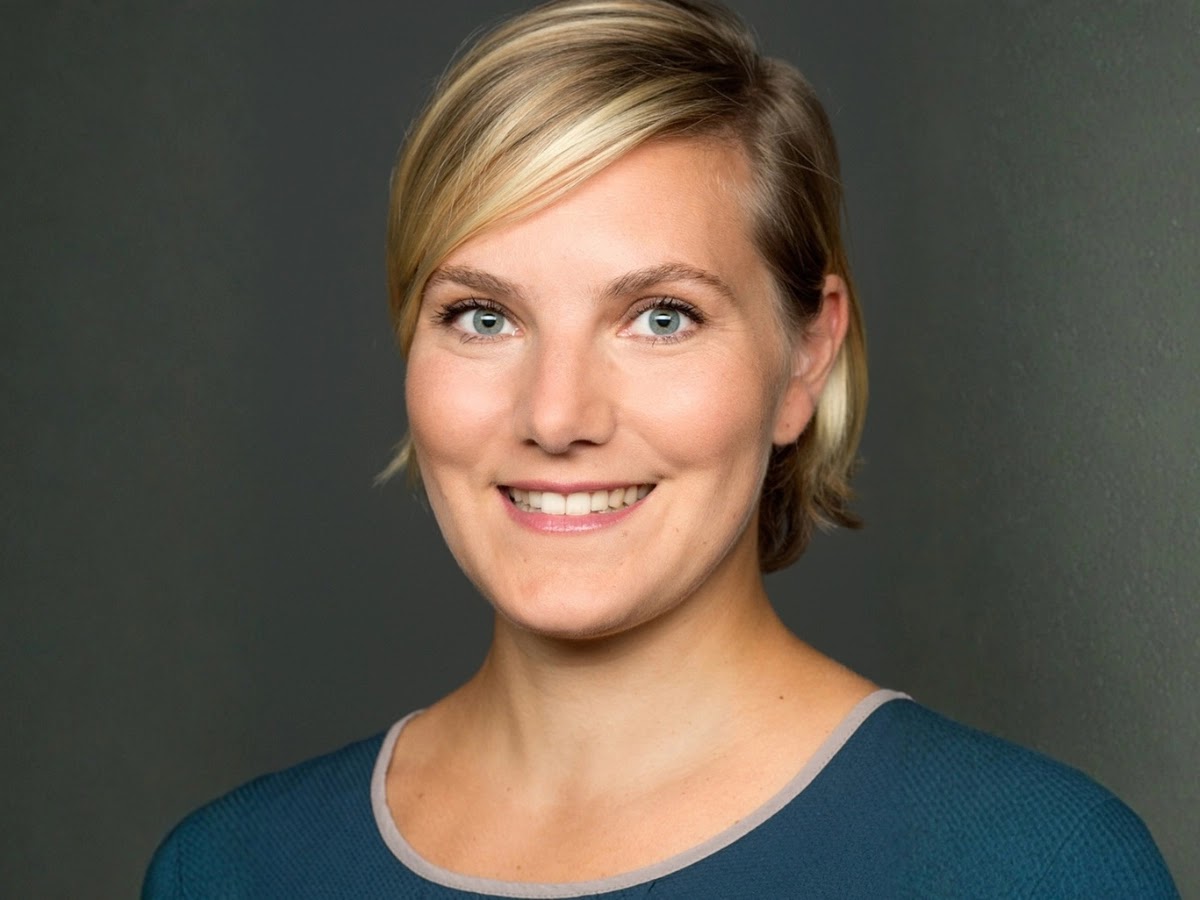
Pia Dorfinger heads the Start-ups and Innovation unit at the German Energy Agency (dena), where she is responsible for national and international programmes supporting young companies, including the global Start Up Energy Transition (SET) platform. She entered the energy sector after studying international business with a focus on energy and environmental management. She has been with dena for around 14 years.
As Director for Start-ups & Innovation at the German Energy Agency (dena), which deep tech fields are you most actively scouting?
Right now, three clusters keep surfacing in everything we look at. The first is grid intelligence: forecasting, flexibility and storage optimisation powered by AI that helps make renewables genuinely dispatchable rather than just there when the wind blows. The second is materials and circularity for the energy transition, from recovery of critical raw materials to low carbon construction materials and next generation batteries. The third is the harder to scale physical deep tech, things like advanced heat, hydrogen and carbon management technologies, where the science is often more mature than the business model around it. What ties these together is that they rarely fit into one neat sector box; they sit at the intersection of energy, industry and digital infrastructure. That is exactly why we run a global scouting process each year through our Start Up Energy Transition platform. We are not just looking within Germany or Europe but casting a global net so we do not miss the team solving the next piece of the puzzle, and they might sit in Rwanda or Singapore right now.
Which startup teams have impressed you most in the past year, and why?
It is genuinely hard to narrow this down, because we saw well over 470 applications from 79 countries in our latest cohort alone, and the calibre kept rising. A few stood out for how they combined technical depth with commercial pragmatism. Flower, a Swedish team using AI to coordinate wind, storage and renewable assets so operators can plan around green power rather than just accept its intermittency, was one. Finmile, a UK logistics team cutting fleet emissions by up to 40 per cent through smarter AI routing, was another, deep tech that pays for itself almost immediately, which is rare. I was also impressed by Cyclic Materials, who have built an industrial process to recover rare earth elements from end-of-life products, unglamorous engineering that quietly solves a supply chain bottleneck the whole electrification agenda depends on. Mykor, a Bristol based team, impressed us for a different reason: they grow structural insulation panels from mycelium and agricultural residues, cutting embodied carbon by around 60 per cent while matching conventional fire safety standards, proof that construction, one of the hardest sectors to decarbonise, still has real room for deep tech to change the material itself rather than just the process around it. And BioMassters in Rwanda showed that some of the most elegant deep tech is not about novelty for its own sake, but about taking proven biomass gasification and making it radically more efficient and accessible. When we brought the strongest of these teams together on stage at our SET Tech Festival in Berlin this spring, it was quite interesting to see how precisely each of them understood their customer's actual pain point.
What's your top advice to a founder trying to work with an organisation like dena for the first time?
Be specific about what you need from us. "Support" is not a request; an introduction to two grid operators piloting flexibility tenders is. Organisations like ours have genuine convening power: access to policymakers and regulators, corporates, investors and a curated network of peers working on adjacent problems, but we can only deploy it well if a founder tells us precisely where the friction is. Second, come with your unit economics honestly worked through, even if they are not perfect yet. Deep tech forgives a slower path to profitability, but only if you can show you understand your own cost structure and where it needs to go. And third: show up more than once. The founders who get the most out of an ecosystem like ours are not the ones who nail a single pitch, but rather the ones who turn up at the smaller, less glamorous sessions too, use spaces like our SET Hub focus events and the Future Energy Lab as a base while they are in Berlin, keep refining their story, and are still in the room a year later when the timing for a real partnership finally lines up.

Wind and solar built the first generation of Europe’s renewable energy system. The next challenge is harder: unlocking clean energy from resources that are more predictable, more widely available or capable of serving sectors that direct electrification cannot reach. These five European companies are moving new approaches to waves, geothermal heat, solar fuels, tidal currents and high-altitude wind from demonstration toward commercial deployment.
CorPower Ocean | Stockholm, Sweden
- Technology: Wave Energy Converters designed to harvest electricity from ocean waves while actively adapting to changing sea conditions. CorPower’s system uses a phase-control technology that amplifies motion in normal waves while protecting the device during extreme storms, addressing two of wave energy’s historic challenges: efficiency and survivability.
- Customers & Partners: Works with utilities, project developers and energy companies on wave-farm development. Strategic investors and partners include NordicNinja VC, SEB Greentech, EIT InnoEnergy, Cisco Investments, Santander Asset Management, Acario — the investment arm of Tokyo Gas — and GTT Strategic Ventures.
- Use cases: Utility-scale renewable electricity, offshore energy projects and hybrid offshore systems where wave generation can complement wind and reduce variability in renewable power supply.
- Funding: Completed a €53M Series B in 2026, following participation from investors including Algebris Investments and the EIC Fund. CorPower has also secured a €40M EU Innovation Fund grant for its VianaWave project and €30M in Horizon Europe funding for the POWER-Farm initiative.
- Why it matters: Wave energy has remained one of renewable power’s largest technically accessible but commercially underdeveloped resources. CorPower is now moving beyond single-device validation toward arrays, certification and industrialised manufacturing — the steps required to turn wave energy from an engineering experiment into an investable infrastructure category.
→ CorPower is developing VianaWave in Portugal, a planned 10 MW pre-commercial wave farm using 30 converters and expected to generate around 30 GWh annually. Commercial operation is targeted for 2028/29.
GA Drilling | Bratislava, Slovakia
- Technology: Advanced downhole drilling technology designed to make deep geothermal resources economically accessible. Its NexTitan system operates directly behind the drill bit to improve force transmission, drilling performance and stability in hard rock formations that make conventional deep drilling expensive.
- Customers & Partners: Targeting geothermal developers, large industrial energy consumers and oil-and-gas operators. GA Drilling has worked with Petrobras on offshore drilling applications and validated NexTitan at the NORCE Ullrigg research facility in Stavanger, Norway.
- Use cases: Deep geothermal electricity and heat production, industrial baseload power, hard-rock drilling and the transfer of existing oil-and-gas drilling capabilities into geothermal energy development.
- Funding: Secured $44.1M in spring 2026, consisting of $24.7M in fresh capital and a $19.4M SAFE conversion, to move NexTitan into commercial deployment.
- Why it matters: Geothermal is one of the few renewable resources capable of providing continuous power independent of weather, but its economics remain heavily constrained by drilling cost and geological risk. If new drilling systems can economically reach deeper and hotter rock, geothermal could expand far beyond the relatively limited regions where it is competitive today.
→ In February 2026, NexTitan was validated under real downhole conditions in Norway, reaching 32,000 lbf of thrust.
Synhelion | Zurich, Switzerland
- Technology: Solar thermochemical technology that concentrates sunlight to generate high-temperature process heat and convert carbon-containing feedstocks into renewable synthetic fuels. Unlike conventional photovoltaics, Synhelion uses solar energy to produce energy-dense molecules rather than electricity.
- Customers & Partners: Customers and strategic partners include SWISS, Lufthansa Group, Eni, CEMEX, SMS group, Wood, AMAG Group, Zurich Airport and Pilatus Aircraft. SWISS has signed a binding five-year agreement to purchase at least 200 tonnes of solar jet fuel annually from 2027.
- Use cases: Sustainable aviation fuel, renewable diesel and gasoline for aviation, heavy transport, construction equipment and other sectors where direct electrification is technically difficult or economically unattractive.
- Funding: In its latest funding round (Series B), Synhelion raised CHF 22M; its DAWN facility also received €3.92M from Germany’s Federal Ministry for Economic Affairs, while a larger commercial demonstration project in Jülich was selected for support under North Rhine-Westphalia’s Produktives.NRW programme in 2026.
- Why it matters: Some of the hardest parts of the energy transition do not need another source of electricity — they need a scalable replacement for fossil molecules. Synhelion is attempting to use renewable heat to produce drop-in fuels compatible with existing aircraft, engines, refineries and fuel infrastructure.
→ DAWN, Synhelion’s first industrial-scale plant in Jülich, has been producing several thousand litres of renewable fuel annually since 2024. The company’s next plant is intended to demonstrate commercial operability and bankability, with the majority of its planned output already covered by binding long-term offtake agreements.
SeaQurrent | Dokkum, Netherlands
- Technology: A multi-wing underwater kite that moves across tidal currents rather than remaining fixed in one position. The TidalKite converts the resulting traction force into electricity, allowing the system to sweep a larger area of moving water and extract energy from relatively low-velocity tidal flows.
- Customers & Partners: Backed by investors and public-sector partners including EIT InnoEnergy, Invest-NL, PMH Investments, NOM and the Frisian Development Agency. SeaQurrent is also participating in European demonstration programmes focused on tidal and hydrokinetic energy.
- Use cases: Predictable renewable electricity for coastal communities, islands and grids with high shares of intermittent wind and solar generation, as well as future tidal-energy farms in suitable coastal and river locations.
- Funding: Raised more than €4.8M in a Series A backed by EIT InnoEnergy, Invest-NL, PMH Investments, FOM and NOM. The company has subsequently received additional European and regional project support, including funding for the TidalKite 2.0 programme.
- Why it matters: Tidal power has one system-level advantage that wind and solar cannot offer: its output can be predicted years in advance. SeaQurrent is trying to make that resource economically accessible with a lighter, dynamically moving system designed for currents where conventional tidal turbines may be less effective.
→ SeaQurrent estimates that full deployment of its technology in the Dutch Wadden region could generate electricity equivalent to the consumption of roughly 50,000 households, while providing a steadier production profile to complement wind and solar.
Kitepower | Delft, Netherlands
- Technology: Airborne Wind Energy Systems that replace the tower and blades of a conventional wind turbine with an autonomously controlled kite connected to a ground-based generator. The kite flies repeated crosswind patterns at altitudes of roughly 250–400 metres, pulling a tether that drives electricity generation on the ground.
- Customers & Partners: Targeting construction sites, remote industrial operations, islands and other locations where diesel generators remain common or conventional wind turbines are difficult to deploy. Previous projects and collaborations include NATO-linked programmes, RWE Renewables and European demonstration initiatives for mobile airborne wind energy.
- Use cases: Mobile and off-grid renewable power, temporary construction sites, microgrids, remote infrastructure and locations where the foundations, transport requirements or permitting burden of conventional wind turbines make deployment impractical.
- Funding: Raised €3M in a Series A from ENERGIIQ, Stichting ifund and Windhandel Beheer, followed by additional crowdfunding and grant financing. Its 2025 FunderNation campaign closed with approximately €728,000 committed by 313 investors to support further commercialisation and production scale-up.
- Why it matters: Modern wind power requires enormous physical structures largely because generators need access to stronger winds higher above the ground. Airborne wind asks whether much of that tower, steel, concrete and logistics infrastructure can be removed entirely — opening wind generation to locations that conventional turbines cannot economically serve.
→ Kitepower is now shifting from technology demonstration toward an Energy-as-a-Service model, using its mobile Hawk system as the first commercial product while developing a larger next-generation Falcon platform.
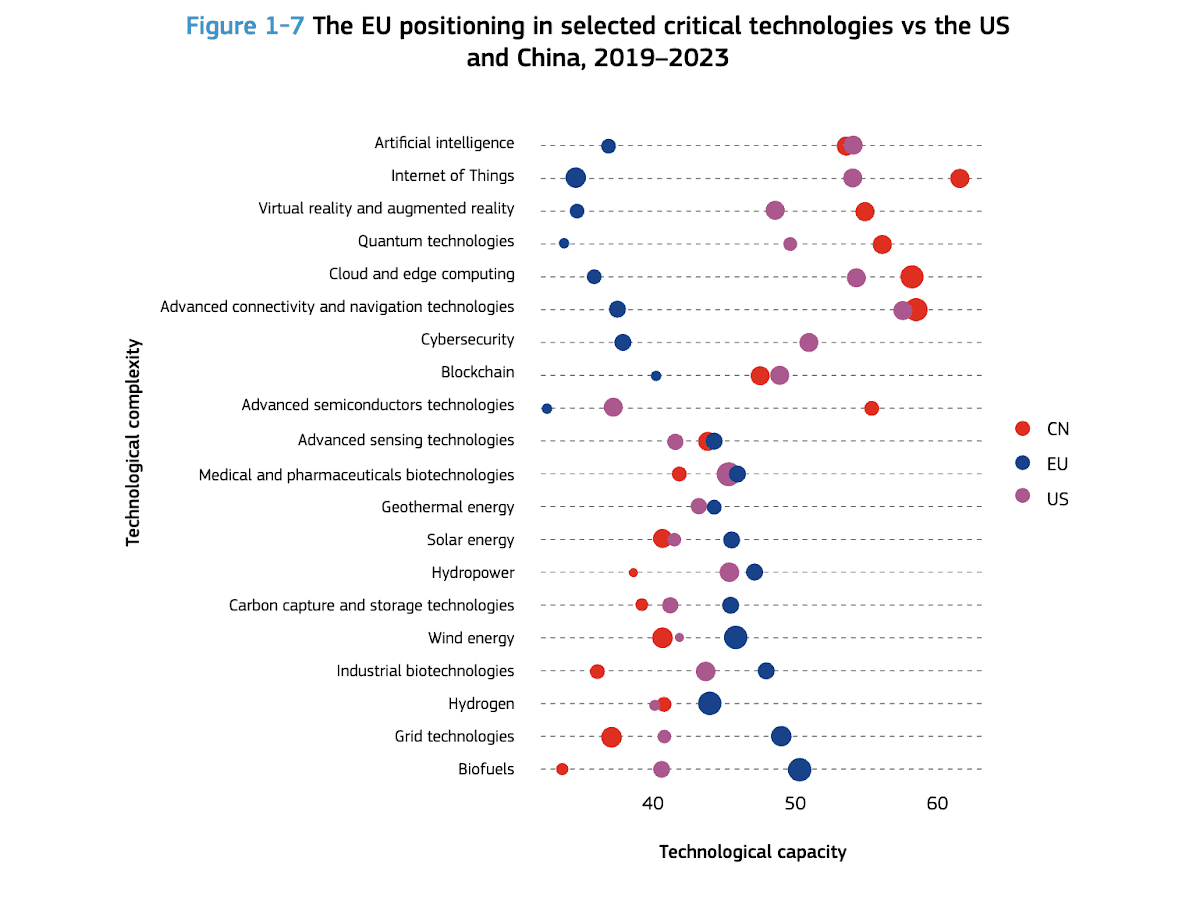
The innovation gap with the US and China remains substantial in digital technologies, whereas the EU retains some strength in green tech fields. Source: Science, Research and Innovation Performance of the EU 2026.
Europe is producing world-class research faster than it is producing world-class technology companies.
Published on 1 October, the European Commission’s new Science, Research and Innovation Performance of the EU 2026 report is its flagship biennial assessment of Europe’s research and innovation system. Across 12 chapters, it examines R&D investment, scientific leadership, critical technologies, AI, access to finance, regional fragmentation and the conditions required to scale innovative companies. For Europe’s deep tech ecosystem, the message is clear: the continent retains meaningful strengths in research and several strategic technology fields, but remains constrained by underinvestment, fragmented markets and insufficient scale-up capital.
Here are five key takeaways:
1. Europe is still hundreds of billions short of its own R&D ambition. The EU would need around €565 billion in additional R&D investment by 2030 to reach its long-standing target of spending 3% of GDP on research and development. The report also warns that private R&D investment tends to contract during periods of uncertainty, increasing the importance of public capital in maintaining investment momentum.
2. Europe’s problem is increasingly one of productivity, not simply invention. Over the past 25 years, labour productivity growth in the EU has been roughly half that of the US. Since 2000, US productivity increased by around 50%, compared with approximately 26% in the EU. The Commission links part of this gap to weaker business dynamism, market fragmentation and the ability of firms to adopt and commercialise new technologies at scale.
3. Europe remains strong in green technologies — but is losing ground in digital deep tech. The EU retains comparatively strong positions in areas such as wind, grid technologies, geothermal, biofuels and industrial biotechnology. By contrast, its position is substantially weaker relative to the US and China in technologies including AI, cloud and edge computing, advanced semiconductors and several other critical digital fields. Europe’s deep-tech competitiveness is therefore increasingly asymmetric: stronger in parts of the physical and green economy, weaker across much of the digital stack.
4. Capital becomes scarcer precisely when European companies need to scale. Europe performs relatively well in attracting capital into green sectors, which accounted for around or above 20% of global VC investment in several categories between 2023 and 2025. But the picture changes in digital and deep tech, where Europe attracts a significantly smaller share of global investment. The report identifies later-stage venture capital as a particular bottleneck, limiting the ability of promising European companies to grow into global leaders.
5. Fragmentation is becoming a technological disadvantage in its own right. The report finds that fragmentation across Europe’s research and innovation system worsens the EU-US innovation gap in many advanced technology fields. The issue is not only how much Europe invests, but how effectively capital, research institutions, companies and markets connect across borders. For deep tech, where companies depend on specialised talent, large pools of capital, industrial partners and cross-border customers, a fragmented European market effectively reduces the scale of the ecosystem before companies have even begun to compete globally.
Three upcoming events bringing together founders, investors, corporates and policymakers shaping Europe's technological future.
Deep Tech Summit 2026 | Warsaw, Poland
26–27 October 2026
Bringing together over 1,000 participants from 30+ countries, including 250+ startups and 150+ investors. The summit connects Central and Eastern Europe's deep tech ecosystem with international capital through curated matchmaking, investor meetings and corporate partnerships.
Horizon Deep Tech Summit 2026 | Madrid, Spain
10–12 November 2026
A three-day gathering connecting research-driven startups, investors and industrial leaders. Supported by the European Commission and featuring the EIC Tech to Market Programme, the summit focuses on commercialising breakthrough research and building strategic partnerships across Europe's deep tech ecosystem.
Slush 2026 | Helsinki, Finland
18–19 November 2026
One of Europe's major founder-investor gatherings, bringing startups and international venture capital together in Helsinki. Two days of investor matchmaking, startup showcases and discussions on scaling technology companies, with opportunities for European deep tech founders seeking international capital.

