Nobody Wants Your Technology
Europe’s top 5 industrial robotics plays, what BSH is scouting, and why AI still struggles to scale on the factory floor

Nobody funds a frontier-tech solution simply because the technology is impressive.
What gets funded and procured is a problem that is defined so precisely, and carries such a visible economic cost, that solving it feels inevitable. Deep Tech Momentum’s Martin Schilling uses the story of the longitude problem to make exactly that point: founders need to start with the loss, not the technology, and be able to express it in one sentence: Who loses how much, because of what specific problem?
That logic runs through this issue: We look at the Top 5 European startups building the intelligence layer for industrial robotics: from Physical AI and dexterous manipulation to fleet orchestration, perception and industrial computer vision. The common thread is that the value increasingly sits above the machine itself — in the software, data and models that allow robots to learn new tasks, coordinate across heterogeneous fleets and operate reliably in changing environments.
Also in this issue:
Mathias Weber of BSH Hausgeräte explains what one of Europe’s largest manufacturers is actually looking for in deep tech — and why startups that understand the corporate’s real operational problem, rather than simply pitching their technology, are far more likely to make it into production.
Deloitte’s new AI in Manufacturing 2026 study shows that while 84% of manufacturers already report measurable value from AI, only around 20% of use cases have scaled across sites — exposing the gap between successful pilots and industrial deployment.
Let’s dig in!
This is part of the book NORTH STAR: The 12 Formulas Behind the World's Most Valuable Deep Tech and AI Companies. How Clarity Compounds into Capital, Customers, and Enterprise Value. Sign up HERE for the waiting list to be amongst the first to receive the book.
On a stormy night in October 1707, a British fleet sailed home from Gibraltar certain it was safely west of the Scilly Isles. The navigators knew their latitude to the mile, as sailors had for centuries. What they could not know was their longitude, their position east to west, because no instrument on earth could tell them. So they guessed, as every fleet before them had, and in the fog they guessed wrong. Four ships struck the rocks and more than 1,400 sailors drowned, the admiral among them.
For centuries the danger had been described the way weak problems always are: navigation is hard, the sea is cruel, people die. All true, and all useless. Then in 1714 Parliament did something different. It defined the problem precisely, no reliable method exists to fix longitude at sea to within half a degree, and it priced it, £20,000, millions in today's money. Named precisely and carrying a number, the problem drew Europe's sharpest minds.
Everyone knew the answer was in the sky. Longitude was an astronomy problem, and the Board of Longitude, packed with astronomers, was certain of it. The man who solved it was a self-taught Yorkshire carpenter named John Harrison, and he built a clock. Longitude was never an astronomy problem, it was a timekeeping problem.
When you build a frontier tech venture, the non-obvious part of the equation is to be crystal clear on the problem you are solving, defined so precisely and priced so credibly that the solution feels inevitable. There is a formula for this.
The formula
[Ideal customer] loses [quantified amount] because of [specific problem].
Here are four frontier tech problems, written correctly:
Defence. Forward air-defence batteries lose about €2M every time they fire a legacy interceptor to destroy a €500 drone, and they face dozens of such drones a day.
Manufacturing. European EV-motor manufacturers lose around 40% of their motor cost, and all of their supply security, to a single country that controls close to 90% of the rare-earth magnets they need.
HPC. AI labs lose 30% to 40% of the GPU performance they have paid for because data movement, not compute, is now the bottleneck, and the gap widens with every model generation.
BioAI. National health systems lose on the order of €1.5B a year because the bone-graft standard of care fails in one patient out of five, driving repeat surgery and complications.
The eight archetypes
Seen from the customer's side, almost every worthwhile frontier tech problem is a variation on one of the following eight.
# | Archetype | The shape of the loss |
|---|---|---|
1 | The Wall | A hard physical or scaling limit no effort gets past |
2 | The Dependency | Reliance on a single supplier or country that can be cut off |
3 | The Asymmetry | Defending against a problem costs far more than causing it |
4 | The Waste | Value lost for good, as heat, spoilage, idle capacity, or money that leaks away unseen |
5 | The Wait | A process so slow it blocks everything downstream |
6 | The Decay | An expensive asset fails far too soon |
7 | The Gap | A needed capability does not exist yet |
8 | The Mandate | A rule or sovereignty requirement the customer must meet or lose the right to operate |
The British parliament never described a clock in 1714. It described ships on the rocks and put millions on ending them, and only then did the answers come. Define the problem from the customer's side that precisely and you will not have to sell the solution. The room will already be reaching for it.
With wishes that you never become the world's most elegant answer to a question nobody was asking,
Martin

Source: PR
Mathias Weber is an innovation and technology leader at BSH Hausgeräte, working at the intersection of industrial transformation, digitalisation and advanced manufacturing. At BSH, Europe’s largest home-appliance manufacturer, he helps shape how technologies such as AI, automation and robotics move from experimentation into real production environments.
Which deep tech fields are you most actively scouting startups in right now?
Advanced materials, sensor technologies, as well as manufacturing technologies are particularly relevant for us when it comes to Deep Tech fields. On the product side, we are looking for novel materials, coatings and sensor technologies that can improve the performance, durability, sustainability and intelligence of home appliances. What excites us are technologies that can create a tangible consumer benefit while being scalable to millions of appliances. At the same time, manufacturing tech is a major focus. With our global production footprint, even small improvements can create significant impact at scale. We are therefore scouting technologies across robotics and automation, advanced manufacturing processes and smarter shop-floor operations.
How do you identify and select the startups worth bringing into BSH's venturing pipeline?
We primarily work with a pull-based approach. That means we don't start with a startup and then look for a use case, we start with a clearly defined innovation challenge from one of our business units. Based on the specific technical and business requirements, we conduct a global benchmarking to identify the best startup solutions available. The most promising candidates then go through a comprehensive assessment, looking not only at the technology and its fit with our requirements, but also at the team, maturity, scalability and ability to work in a corporate environment. In the end, the goal is simple: to select the best possible partner for the specific challenge and build a long-term partnership together.
What's your top advice to a founder trying to work with a company at BSH's scale?
Understand the corporate's real innovation challenges before you start selling your solution. The better you understand the specific problem, requirements and constraints, the better you can demonstrate where your technology creates tangible value. Equally important is understanding how a large corporation operates. There are multiple stakeholders, technical requirements, compliance standards and decision-making processes that may be very different from working with smaller companies. The startups that stand out are those that do their homework. They come in with a strong understanding of our business, speak the language of the relevant business unit and can clearly show how their solution fits into our environment. Great technology gets you into the conversation, understanding how to make it work at corporate scale is what moves the partnership forward.

Here are five European companies building an intelligence layer for industrial robotics in the form of software that allows machines to learn new tasks, coordinate across fleets, understand industrial processes and adapt to changing environments.
Acumino | Athens, Greece
Technology: Hardware-agnostic Physical AI for dexterous industrial automation. Acumino’s AI-driven robot teaching framework turns demonstrations and robot interaction data into models that can be transferred across different robotic platforms. Its AcuBrain infrastructure virtualises testing and allows a single dataset to be used across supported robots including Universal Robots, FANUC, Mitsubishi MELFA and others.
Customers & Partners: Schaeffler, DXC Technology, Universal Robots and MegaChips are among its publicly disclosed industrial and technology partners. Acumino has demonstrated applications including cable handling, package folding and complex bimanual manipulation.
Use cases: Flexible-object handling, industrial assembly, packaging, cable installation, tool handling and other dexterous tasks that have historically been difficult to automate with conventionally programmed robots.
Funding: $11.7M Seed in June 2026, led by Radar Ventures, with participation from Schaeffler, Big Pi Ventures, MegaChips, LDV Partners and Bülent Çelebi. The round followed an earlier $6.5M financing in 2024. Acumino was also selected for Google DeepMind’s first European Robotics Accelerator.
Why it matters: Industrial robotics has historically been constrained by integration: every new task, machine and production environment creates another engineering project. Acumino is trying to separate robotic intelligence from the underlying hardware. If successful, manufacturers could train capabilities once and deploy them across a heterogeneous installed base.
→ The bigger shift: Robot hardware increasingly becomes infrastructure. The defensible layer may be the data, models and deployment system that determine what those machines can actually do.
mimic robotics | Zurich, Switzerland
Technology: Physical AI for dexterous manipulation. mimic combines robotic hands, conventional industrial robot arms and foundation models trained on real human demonstrations. Workers perform tasks using proprietary data-capture equipment; those demonstrations are converted into imitation-learning models that allow robots to reproduce the task, adapt to variation and self-correct during execution.
Customers & Partners: mimic is working with manufacturing and logistics companies on industrial pilots, although the company has not publicly disclosed the full customer list. Its technology originated from ETH Zurich’s Soft Robotics Lab.
Use cases: Manual production and logistics tasks requiring human-like dexterity: handling variable objects, manipulating tools, assembly and other processes where conventional pre-programmed automation becomes uneconomic.
Funding: $16M Seed in 2025, led by Elaia and Speedinvest, with participation from Founderful, 1st Kind, 10X Founders, 2100 Ventures and the Sequoia Scout Fund. mimic was spun out of ETH Zurich in 2024.
Why it matters: mimic is making a deliberate bet against the idea that every industrial task requires a full humanoid robot. Instead, it brings human-like manipulation capabilities to established industrial robot architectures — potentially giving manufacturers a faster path from rigid automation to adaptive Physical AI.
→ The bigger shift: The winner in industrial humanoid robotics may not look particularly humanoid. For many factories, adding intelligence and dexterity to the millions of robotic arms already installed could prove considerably more economical than replacing them.
HIVE | Kristiansand, Norway / London, UK
Technology: An AI autonomy and orchestration layer for existing industrial machines. HIVE retrofits equipment with sensors, compute and control systems, turning machines such as wheel loaders into autonomous assets and connecting them into coordinated fleets. The company calls the underlying platform its “silicon brain”.
Customers & Partners: HIVE has publicly documented deployments or collaborations with industrial groups including Yara and Veidekke, as well as work around Volvo machinery. Its systems are already operating in real industrial environments across the Nordics.
Use cases: Autonomous material handling, quarry and mining operations, construction, road maintenance, logistics and other machine-intensive processes. HIVE’s model is designed around retrofitting equipment customers already own rather than replacing the fleet.
Funding: $15M Seed in 2026, led by SuperSeed with participation from Veriten, Skyfall Ventures and Nysnø Climate Investments. The capital is being used to scale deployments and develop the platform across additional machine classes and markets.
Why it matters: Industrial autonomy becomes much more valuable when it stops being tied to one machine or one OEM. HIVE is effectively trying to create an operating layer across heterogeneous physical assets — converting existing heavy machinery into software-defined robotic capacity.
→ The bigger shift: Factories and construction sites may eventually manage machines the way cloud infrastructure manages compute: heterogeneous assets underneath, one orchestration layer above them.
Kognic | Gothenburg, Sweden
Technology: Data infrastructure and quality-control software for AI-powered perception systems. Kognic helps industrial and automotive teams collect, annotate, validate and manage the large volumes of sensor data required to train and deploy computer-vision and autonomy models in complex physical environments.
Customers & Partners: Kognic works with automotive manufacturers, suppliers and industrial technology companies. Its platform is designed for organisations developing perception systems that must operate reliably across changing conditions, sensor configurations and edge cases.
Use cases: Sensor-data management, computer-vision training, autonomous-machine development, quality assurance, scenario coverage and validation of AI systems used in vehicles, factories and other industrial environments.
Funding: Kognic raised €8.8 million in funding from investors including Metaplanet, Neudi Kapital, and Stena Sessan.
Why it matters: Physical AI depends on more than models and hardware. It requires high-quality data, traceability and systematic validation across the long tail of real-world conditions. Kognic is building part of that missing infrastructure layer.
→ The bigger shift: In industrial AI, the bottleneck may move from model creation to data quality, scenario coverage and proof that autonomous systems behave reliably outside the lab.
Robovision | Ghent, Belgium
Technology: An industrial computer-vision and AI platform for building, deploying and managing visual inspection and perception systems. Robovision provides tools that allow industrial teams to train AI models on proprietary data, integrate them with cameras and production equipment, and operate them in demanding environments without building the entire software stack from scratch.
Customers & Partners: Robovision works with industrial manufacturers, food-processing companies, agriculture and other organisations deploying computer vision in production environments. Its platform has been used across applications including quality inspection, sorting, grading and machine perception.
Use cases: Automated visual inspection, defect detection, food sorting, agricultural perception, quality control, production monitoring and other applications where machines must interpret visual information reliably at industrial speed.
Funding: Robovision has raised €36m Series A round led by Target Global and Astanor Ventures institutional venture financing and developed into an established European industrial-AI company.
Why it matters: Many industrial robots already have the mechanical ability to perform a task. What they lack is reliable perception: the ability to distinguish acceptable from defective, understand variation and make decisions under real production conditions. Robovision is building the visual intelligence layer that allows automation systems to move beyond fixed rules and controlled environments.
→ The bigger shift: Industrial AI will not be defined only by autonomous movement. It will also depend on machines that can see, interpret and make quality decisions at production speed.
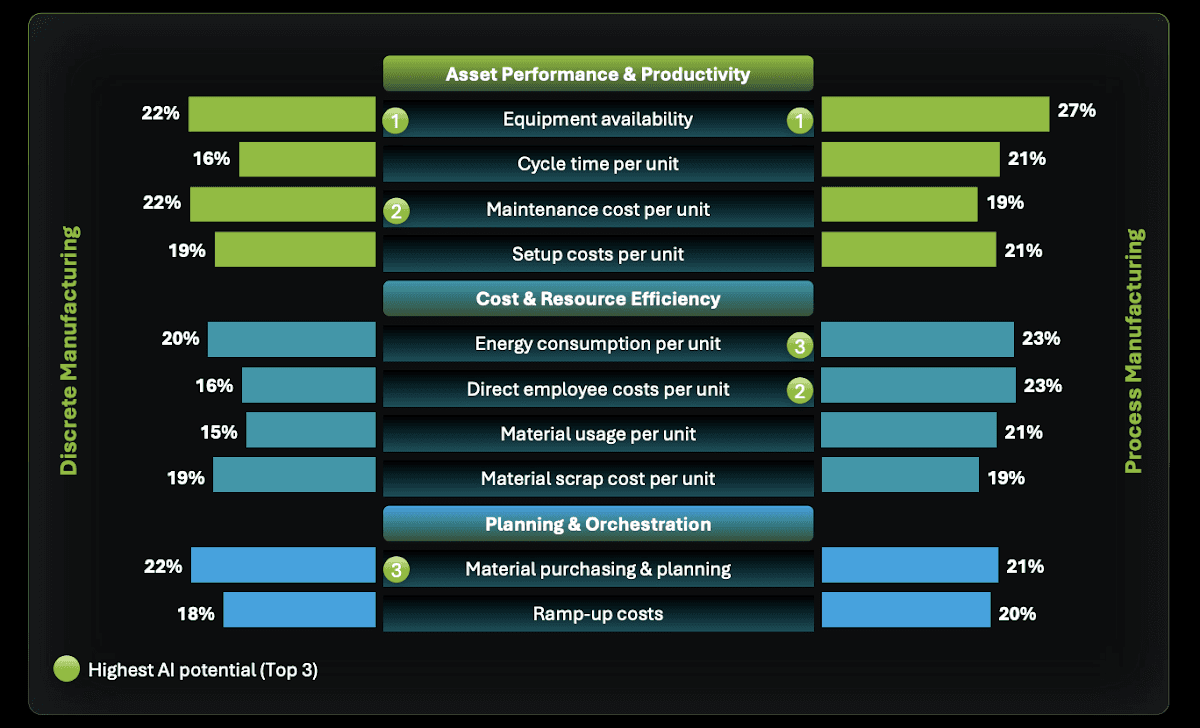
Average efficiency potential of AI across key manufacturing KPIs, based on KPI impact assessments of selected and described AI use cases across industry areas. Source: AI in Manufacturing 2026
AI in manufacturing is moving out of the lab and onto the shop floor — but the gap between a successful pilot and industrial-scale deployment remains wide.
Deloitte’s new AI in Manufacturing 2026 report surveys more than 140 manufacturing organisations across industries, company sizes and regions. Europe is particularly well represented: 43% of respondents are from Europe excluding Germany, with another 14% from Germany. The study examines AI maturity, deployment, operational impact and the barriers preventing manufacturers from scaling AI across plants and processes.
Here are 5 key takeaways:
1. AI is already creating value — but only a fraction of use cases scale.
Around 84% of manufacturers report measurable value from AI, yet only about 20% of use cases are scaled across sites. The bottleneck is no longer whether AI works. It is whether companies can industrialise it across different plants, production lines and operating environments.
2. The strongest use cases sit closest to the physical production process.
Quality, production and logistics dominate current deployment. Quality alone appears in 62% of reported functional applications, followed by production at 57% and logistics / supply chain at 49%. These are exactly the environments where sensor data is dense, feedback loops are short and operational impact can be measured directly.
3. Physical AI is emerging, but it is still early.
Deloitte finds that 18% of the AI technology mix already involves Physical AI or closed-loop systems — AI embedded in machines, sensors, vision systems and robotics that can perceive, decide and physically act. That is still smaller than conventional ML and GenAI, but strategically it may be the most consequential category for Europe’s industrial base.
4. The value is material: manufacturers see roughly 20% improvement potential across core KPIs.
Across asset productivity, costs and orchestration, respondents estimate AI improvement potential broadly around the 20% mark. In process manufacturing, equipment availability reaches 27%, while chemical and physical transformation shows an average efficiency potential of 32%. The highest gains tend to appear where processes are complex, variable and difficult to control.
5. Trust is becoming as important as model performance.
Once AI starts influencing production-critical decisions, failure has physical consequences. 79% of respondents cite operational disruption as a perceived risk, while 51% point to cybersecurity and data protection. Scaling industrial AI therefore requires more than stronger models: manufacturers need robust data, validation, governance and systems that operators are willing to trust.
The broader signal is clear: the next phase of industrial AI will not be won by the companies running the most pilots. It will be won by those capable of connecting prediction, orchestration and Physical AI into reliable end-to-end production systems.
For Europe, that matters. Its industrial advantage lies not in competing for consumer AI interfaces, but in applying intelligence to the factories, machines, process knowledge and physical assets it already controls.
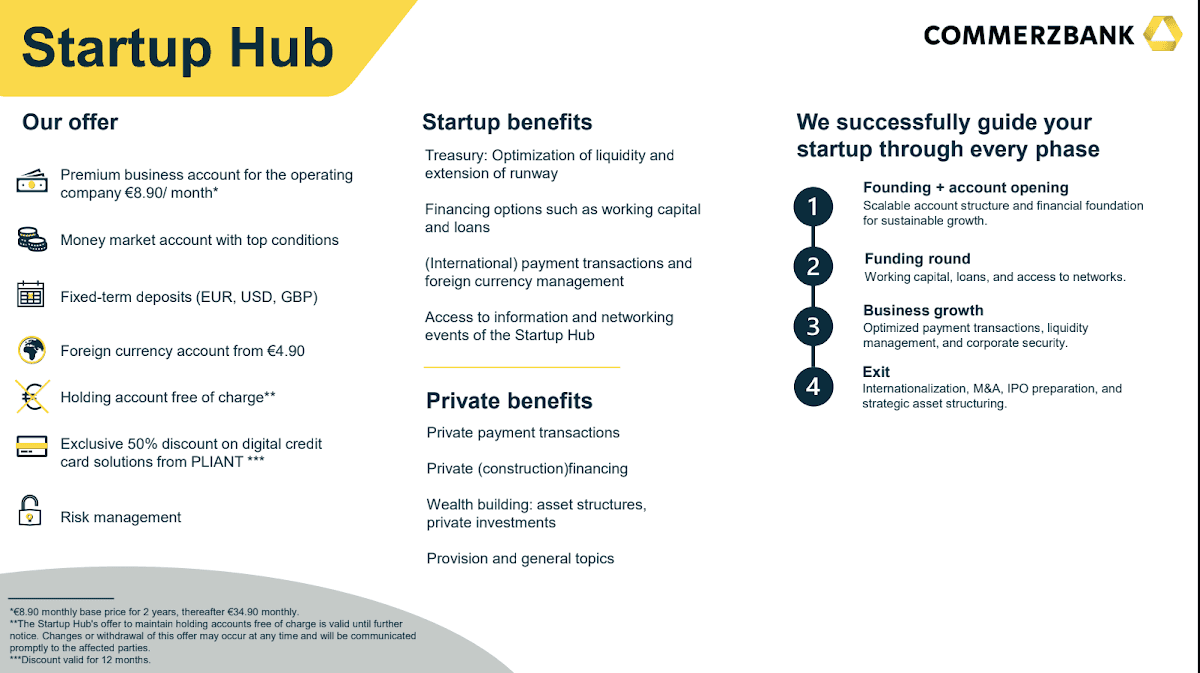
From incorporation to funding rounds, international growth and exit, the Commerzbank Startup Hub supports startups and investors across their financial journey. The offer covers business and holding accounts, liquidity and treasury management, working-capital financing, international payments and access to the Startup Hub’s network and events.
For DTM startups, this means a dedicated team that understands the specific financing and banking needs that emerge as companies scale — from extending runway to preparing for internationalisation or M&A.
Europe Tech Connect 2026 | 5 October, Munich and 6 October, Berlin
Organised by the Singapore Economic Development Board (EDB), Europe Tech Connect brings a delegation of senior Singapore demand players to Germany to meet European deep-tech companies ready for commercial partnerships. Participating organisations include Changi Airport Group, the Civil Aviation Authority of Singapore, Land Transport Authority, Maritime and Port Authority of Singapore, Ministry of Transport, ST Engineering Ventures and TechX Ventures.
The focus areas span agentic AI, robotics and Physical AI, industrial AI, digital twins, energy and electrification, quantum technologies, nuclear operations and climate tech. The format starts with reverse pitches from the Singapore organisations, followed by curated 1:1 meetings with selected companies.
→ For startups with a tested MVP and commercial readiness, it is a concrete opportunity to explore customer projects, technical partnerships, market entry into Singapore and potential investment.
Register interest by 25 September 2026: Munich, 5 October | Berlin, 6 October
From Circuit to Product: WE Day at MotionLab.Berlin | 24 September | Berlin, Germany
Powered by Würth Elektronik, this full-day hardware event focuses on one of the hardest transitions in deep tech: moving from a working prototype to a robust, manufacturable product. The programme combines engineering talks, hands-on workshops and direct access to Würth Elektronik specialists, covering topics such as EMC testing, wireless communication in industrial environments, connector behaviour and power electronics.
The day also includes a keynote by Alexander Gerfer, CTO of Würth Elektronik eiSos, a founder-focused panel and open lab access, giving teams the chance to bring along prototypes and discuss concrete technical challenges with engineers on site.
Why go: Particularly relevant for hardware and industrial deep-tech founders who are already building and need to de-risk the engineering decisions that can delay certification, manufacturing and market entry.
24 September 2026, from 10:00 | MotionLab.Berlin, Bouchéstraße 12/Halle 20 | €10 for external guests — Register here
And here are three more upcoming Tech Events worth the trip:
We scanned the calendar for the most interesting tech gatherings coming up in Europe — here are three worth having on your radar.
EURO DEFENCE EXPO 2026 | 22–25 September | Essen, Germany
The inaugural EURO DEFENCE EXPO brings defence industry and civil security together in Essen, alongside SECURITY Essen and the NATO Joint Air Power Competence Centre Conference. Across the combined events, organisers expect 800+ exhibitors and around 20,000 professional visitors, with topics ranging from autonomous systems and robotics to AI, cyber, advanced manufacturing, communications and military training.
Why go: A useful snapshot of where Europe’s defence industrial base is broadening beyond traditional primes — and where software, autonomy and manufacturing startups can plug into procurement and established supply chains.
Bits & Pretzels | 28–30 September | Munich, Germany
One of Europe’s largest founder gatherings returns with 7,500 founders, investors and industry leaders, including around 2,000 business angels and VCs and more than 600 enterprise decision-makers. The format combines two conference days with curated founder-investor matchmaking before moving to Oktoberfest for the final day.
Why go: Not a deep-tech conference per se, but one of the better rooms in Europe for capital and corporate access — particularly for founders looking beyond specialist deep-tech investors toward larger growth and industrial networks.
FIRST by FMD | 30 September–1 October | Berlin, Germany
A new European forum focused on the strategic future of semiconductors and microelectronics, bringing together leaders from industry, policy and research. The programme spans the EU Chips Act, advanced packaging, chiplets, semiconductor infrastructure and industrialisation, with speakers from organisations including Intel, GlobalFoundries, Fraunhofer and Siemens Healthineers.
Why go: Europe’s semiconductor challenge is no longer just about fabs. FIRST looks further across the value chain — from research infrastructure and packaging to industrial applications, investment and technological sovereignty.

