The 6 Ultimate Value Models Behind Deep Tech Winners
The six value models behind the world's leading frontier-tech companies, Europe's hottest spacecraft component startups, and The Exploration Company's next big leap.
The real edge in Deep Tech is turning technological advantage into a value model that compounds.
DTM’s founder Martin Schilling analysed around 100 leading frontier-tech companies. As he writes in this week’s The Leap, he found six recurring value models, from compounding flywheels and cost-curve breaks to outcome-based pricing and value-chain compression. The strongest companies deliberately choose their model instead of defaulting to licences, seats or unit pricing — and often stack several over time.
The key question is not only what value does your technology create, but how much of that value can your company keep?
Also in this issue:
- Components and Payloads is where spacecraft get their core capabilities. We let you know which five European startups stand out.
- And more from space: The Exploration Company is thinking much bigger than capsules and closing a funding round of at least $300 million at a $2 billion valuation.
Let’s fly!!
Dear all,
This is part of the book NORTH STAR: The 12 Formulas Behind the World's Most Valuable Deep Tech and AI Companies. How Clarity Compounds into Capital, Customers, and Enterprise Value. Sign up HERE for the waiting list to be amongst the first to receive the book.
In November 2021, in a London office freshly spun out of DeepMind, Demis Hassabis and Colin Murdoch set an audacious goal: solve all disease. A year earlier their AlphaFold2 had done what biology had failed to do for fifty years, predicted a protein's three-dimensional shape from its amino acid sequence. Now they were pointing that machinery at drug discovery itself. The company was called Isomorphic Labs.
Pharma had seen this movie before. A decade of AI-drug-discovery platforms had come and gone, and big-pharma R&D chiefs had settled into a comfortable arrangement: pay the platform a licence fee, run the software in-house, keep the resulting IP. A good deal – for pharma. Isomorphic said no. It would keep its engine internal, design the drugs itself, and take a share of every molecule that reached the market.
The refusal cost them at first. But in January 2024, Novartis and Eli Lilly signed, worth up to $1.2 billion and $1.7 billion in milestones respectively, plus royalties. Johnson & Johnson followed in 2026. Combined potential deal value approached $3 billion, an order of magnitude more than a licence for the same engine would have earned.
Isomorphic's founders made two decisions, not one: how to create value, and how to capture it. Most companies fuse them and default to a licence, a seat or a unit price. Fine as a starting point, but not a value model.
A value model answers both questions at once, in a way that is unique and repeatable.
We have assessed the value models a hundred of the world's leading frontier tech companies – they all fall into one of six categories:
- Compounding flywheel — each customer's data, skills or usage improves the product for every other. The shared loop is a fixed cost, so each new logo lifts gross margin and switching cost at once (e.g. Hugging Face, NEURA Robotics, Helsing).
- Drop-in layer — an upgrade to hardware the customer already owns, no replacement cycle, priced against the uplift unlocked rather than your cost (e.g. Sila Nanotechnologies, ARX Robotics, Lattice).
- Cost curve break — a process breakthrough delivers the same output at ~10x lower cost. You price well below the incumbent and far above your new marginal cost (e.g. SpaceX, Saronic, Cylib).
- Skin in the outcome — take a share of what gets produced, through milestones, royalties, equity or per-unit-of-result fees (e.g. Isomorphic Labs, Oklo, ICEYE).
- Own the input — manufacture supply of a resource, environment or output the world previously couldn't buy, sold under offtake at scarcity pricing (e.g. Varda, Basecamp Research, Ineratec).
- Value chain compression — collapse steps and intermediaries so the customer gets the whole job faster, cheaper and more sovereign. You charge under the old multi-party price (e.g. Redwood Materials, Anduril).
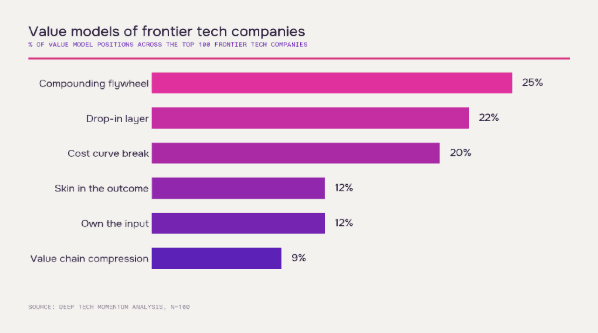
% of value model positions across the top 100 frontier tech companies. Source: Deep Tech Momentum analysis, N=100
The strongest companies don't stop at one value model. SpaceX is the clearest case of stacking.
They started with the cost curve break. The industry accepted that a rocket dies on every flight. SpaceX landed the first stage, reflew it, and now builds ~85% of its components in-house, cutting supplier markups 20–40% per launch. Expendable launch ran $10,000–20,000 per kg; Falcon 9 reached ~$2,700.
Most companies would stop there and sell cheap launches. SpaceX spent the margin instead. It launched its own satellites and became its own biggest customer. Starlink is now as well a compounding flywheel: subscribers fund constellation density, density improves coverage, coverage wins subscribers.
Generational frontier tech companies don’t compete with a cheaper rocket, but with two meters running at once. The first one pays for the second.
A rival can copy your engine, Isomorphic's competitors can build a folding model. But they can't negotiate a royalty on a drug someone else already approved.
Three questions worth exploring when you build your value model:
- Which of the six are you running today, and did you choose it or inherit it?
- Could a customer replicate your technology by hiring engineers and buying compute? If not, share-of-outcome capture is probably available to you.
- Which second model are you earning the right to stack, and which contract will prove it? Two chosen deliberately is what generational companies often do.
With hope you're designing the meter, not just the engine,
Martin
The Exploration Company is thinking much bigger than capsules. According to Handelsblatt, the Franco-German space startup is closing a funding round of at least $300 million at a $2 billion valuation — capital it plans to use to develop Yrene, a reusable heavy-lift rocket capable of carrying up to 40 tonnes to low Earth orbit. That would put TEC well beyond Europe’s current launcher class and into direct competition with ArianeGroup, while reducing its dependence on SpaceX for flying its Nyx cargo capsule.
The move is a significant bet on European control of the full space-transport stack. TEC is already developing the Storm methane engine and plans a new engine manufacturing facility in Mönchengladbach, with Yrene targeted for completion within roughly eight years. If the company can execute across capsule, engine and launcher development, it could become one of the most vertically integrated space players in Europe — and an important test of whether European private capital can support infrastructure-scale deep tech ambitions.
Components & Payloads covers the critical hardware inside and aboard spacecraft — from power and propulsion systems to sensors, communications and mission-specific payloads. These are the five most exciting European startups doing just that.

Astradyne | Bari, Italy
- Technology: Ultra-lightweight, compact solar arrays for satellites, combining advanced photovoltaic systems with flexible, textile-based structures.
- Customers: Satellite manufacturers, integrators and operators across Earth observation, telecommunications and dual-use missions; Astradyne lists organisations including Thales Alenia Space, Leonardo, ESA and the Italian Space Agency among those it has worked with or been supported by.
- Use cases: Satellite power generation, compact deployable solar arrays for CubeSats and microsatellites, and higher-power spacecraft architectures.
- Funding: €2M Seed led by Primo Capital's Primo Space Fund, with participation from Galaxia, Obloo Ventures and Eureka! Venture SGR.
- Why it matters: As satellites become more capable and power-hungry, onboard energy generation is becoming a harder constraint. Astradyne is attacking that bottleneck from the hardware level, aiming to deliver more power without adding the mass and stowed volume associated with conventional solar arrays.
→ Astradyne's technology originated around flexible electronics and textile substrates, allowing solar arrays to fold into unusually compact configurations before deployment in orbit.
Space DOTS | London, United Kingdom
- Technology: Miniaturised in-orbit sensing payloads combined with an AI-powered space environmental intelligence platform.
- Customers: Spacecraft manufacturers, satellite operators, insurers and defence organisations; individual commercial customers have not been publicly disclosed.
- Use cases: Measuring radiation, interference and other orbital conditions; attributing spacecraft anomalies; mission planning; threat detection and forecasting.
- Funding: €1,3M Seed led by Female Founders Fund, with Feel Ventures, GE and existing investor Sie Ventures, bringing total funding to $3.2M.
- Why it matters: Satellites are increasingly operating in crowded and contested environments, but operators still rely heavily on models rather than real-time knowledge of what spacecraft are actually experiencing. Space DOTS is building the sensing layer to close that gap, turning tiny orbital payloads into a distributed source of environmental intelligence.
→ Rarely enough in deep-tech und new space in particular: Space DOTS is a female led startup.
Stellar Alpina | Dübendorf, Switzerland
- Technology: Compact rotating detonation rocket engines and propulsion architectures for in-space mobility.
- Customers: No commercial customers have yet been publicly disclosed; the company is still at pre-seed stage and developing its first flight engine.
- Use cases: Orbital transfers, spacecraft repositioning, high-energy missions, cislunar logistics and ultimately lunar cargo delivery.
- Funding: € 3,7M Pre-Seed led by Founderful, with participation from LP&E and strategic deep-tech investors.
- Why it matters: Falling launch costs are shifting the next infrastructure bottleneck from getting into orbit to moving once there. Stellar Alpina is betting that rotating detonation engines can make spacecraft propulsion more compact and efficient, opening up more flexible orbital transport and eventually deeper-space logistics.
→ Just 82 days after incorporation, the team built its test infrastructure and completed eight hotfires of Engine 0, observing up to five stable detonation waves.
OhmSpace | Rome, Italy
- Technology: High-temperature resistojet electric propulsion systems using safe, low-cost propellants such as water and inert gases.
- Customers: Satellite manufacturers and operators from nanosatellites to larger LEO and GEO platforms; ESA is a development partner, while OhmSpace has also publicly referenced collaborations with HEX20 and OHB Sweden.
- Use cases: Orbit raising, satellite manoeuvring, collision avoidance, constellation deployment and spacecraft lifetime extension.
- Funding: €2.5M Seed led by Galaxia, with participation from Takeoff, Scientifica Venture Capital and Deep Ocean Capital.
- Why it matters: Propulsion is becoming essential rather than optional as satellite constellations grow and orbital traffic intensifies. OhmSpace wants to combine the higher thrust associated with chemical systems with the efficiency and safer propellants of electric propulsion — targeting a subsystem that could become standard infrastructure on increasingly manoeuvrable spacecraft.
→ Its first commercial system, STAR-Water-nano, literally uses water as propellant; the company has been preparing dedicated in-orbit demonstration missions to validate the technology.
Astrolight | Vilnius, Lithuania
- Technology: Laser-based optical communication terminals and ground infrastructure for space-to-ground and space-to-space connectivity.
- Customers: Satellite operators, defence organisations and institutional space programmes; publicly announced partners and projects include Cailabs, the Lithuanian Navy, ESA and Aristotle University of Thessaloniki.
- Use cases: High-bandwidth satellite downlinks, inter-satellite links, secure defence communications and optical ground-station connectivity.
- Funding: €2.8M Seed led by Balnord, joined by EIFO, Coinvest Capital, 3NGLS and Rita Sakus.
- Why it matters: The amount of data generated in orbit is rising faster than traditional radio-frequency infrastructure can comfortably handle. Astrolight is building both sides of the optical link — terminals in space and infrastructure on Earth — with the ambition of creating a European optical backbone for high-capacity, resilient satellite communications.
→ Astrolight was selected for NATO's DIANA programme and has already demonstrated its laser technology outside space, including a free-space optical link between Lithuanian Navy vessels.

Current and future levels of AI adoption: Only 10% report scaled AI with repeatable ROI today, versus 74% expecting to be there in 12 months. Source: KPMG Global Tech Report 2026: Technology, July 2026
The technology race is moving into a harder phase: access to AI and digital tools is becoming ubiquitous, while the ability to turn them into repeatable business value remains rare.
KPMG’s Global Tech Report 2026: Technology examines how large technology companies are investing in, deploying and scaling AI and other digital technologies. The study draws on more than 155 senior technology leaders at companies with at least $1 billion in revenue, spanning EMEA, the Americas and APAC. Respondents include CIOs, CTOs, CDOs and other senior technology executives across both private and listed companies, making the report less a view of experimentation at the frontier than a snapshot of how major technology organizations are trying to industrialize it.
Here’s 5 key takeaways:
1. Adoption has become table stakes — scale has not.
More than 90% of respondents are already actively deploying technologies across AI, cloud, data and cybersecurity. But across many technologies, the largest group remains stuck in the phase where projects are funded yet encountering barriers to scale. The constraint has shifted from access and budget to execution.
2. AI is everywhere, but only 10% are producing ROI at scale.
Every respondent has started AI initiatives, and AI now contributes roughly 21–40% of total digital value for most technology companies. Yet just 10% say they are running AI in production at scale with consistent returns across multiple use cases. Strikingly, 74% expect to reach that level within 12 months — a huge jump that will test whether today’s pilots can actually become infrastructure.
3. Capital is abundant; legacy infrastructure is eating the returns.
74% of technology organizations invest more than $50M annually in digital technology and 51% spend more than $100M. The investment is producing measurable value — 62% report more than $100M in digital value over the past year — but 60% say legacy systems and processes are reducing their technology ROI. Modernization is increasingly becoming a prerequisite for innovation rather than a separate IT exercise.
4. The AI race is becoming a workforce and governance challenge.
Technology companies are moving quickly into agentic AI: 90% say they are investing in agentic AI for a hybrid workforce, and the same share expects managing AI agents to become an important skill. But 54% also report employees feeling left behind, suggesting deployment is moving faster than organizational adaptation in many companies.
5. Cybersecurity, talent and data are emerging as the real strategic bottlenecks.
70% of technology leaders identify access to skills and talent as a challenge, while cyber-risk expectations are rising sharply: 41% expect cyberattacks to be a major AI concern within two years, up from 36% today. At the same time, 87% believe their organizations need to take more risk on emerging technologies. The challenge is increasingly to accelerate without weakening resilience, trust or control.
We scanned the calendar for the most interesting tech gatherings coming up in Europe — here are three worth having on your radar.
NORDEEP | Espoo, 16–17 September
One of Europe’s most focused deep-tech gatherings, bringing together founders, investors and industrial players across quantum, chips, photonics, robotics, advanced materials, dual use and space.
Cambridge Tech Week | Cambridge, 14–18 September
A strong pulse check on Europe’s science-to-market pipeline, with deep-tech founders, university spinouts, investors and corporates converging in one of the continent’s most important innovation clusters.
AI, Data & Quantum Summit | Berlin, 22–23 September
Berlin brings AI, data and quantum under one roof, with more than 2,000 leaders from startups, industry, research and policy debating what moves from experimentation to real deployment next.

