Why You Can't Build A Fusion Reactor In A Techno Club
Berlin became Germany's startup capital by accident. Europe's deep-tech economy will need to be built by design.
Berlin's startup story began with empty factories, cheap rents and no plan. Some of you might remember these wild days. DTM founder Martin Schilling sure does. He recalls the early 2000s when artists moved into the city and soon tech followed: first were the hackers, then came founders and software companies — and eventually Germany's first unicorns.
It is a brilliant story. But it is also the wrong playbook for the next chapter of European competitiveness, Martin argues in this week's The Leap: You can build a creative economy from tolerance, talent and chaos. But you cannot build a fusion reactor, a quantum computer, a defence neo-prime or a sovereign battery supply chain the same way.
That is the central tension in this issue: Europe has the ingredients for deep tech, but not yet the scale machine. Drumbeat Capital's 2026 Deep Tech Report puts numbers behind that discomfort. In 2025, U.S. deep tech startups raised $141B, almost 9x Europe's $16B. At later stages, the gap becomes even sharper. Europe has the engineers, the universities, the industrial base and the scientific depth. What it still lacks is the playbook that turns those assets into globally dominant companies.
Also in this issue:
Five early-stage European battery startups to watch: From solid-state electrolytes and lithium-sulfur cells to ultra-thin batteries, iron-air storage and redox flow systems, we spotlight the companies building the next battery portfolio beyond lithium-ion.
Germany's AI reality check lands in Stuttgart: On June 30, the Deutscher KI Gipfel brings together 1,200 decision-makers, 60+ speakers and four stages to ask what is already working in AI — and what German industry can actually replicate.
Close the deals that shouldn't slip: Cosa is offering DTM members a free Pipeline Screen + "Unstuck Your Deal" coaching. Reply "COSACOSA."

Dear all,
Berlin, 1990. The Wall is down. The factories are empty. The rents are almost nothing. And nobody has a plan.
What followed wasn't engineered by a ministry or a development board. Artists moved into the vacant buildings. Techno filled the abandoned power plants. The Chaos Computer Club turned hacking into a civic movement. A generation arrived because Berlin was the one place in Europe you could build something from scratch — cheaply, freely, without asking permission.
Three decades later, that accident became Germany's unicorn capital. Berlin has now more than 20 unicorns — more than half of all the unicorns in Germany — from N26 and Trade Republic to Zalando, Delivery Hero, Enpal and, most recently, n8n. No other German city comes close.
The economist Richard Florida explained why, twenty years before any of them existed. In The Rise of the Creative Class, he argued that cities attract talent not with tax breaks but with three Ts: Technology, Talent and Tolerance. Berlin is the purest European proof of his thesis. It led with Tolerance — "poor but sexy", the most un-German city, where almost everything was allowed. The Talent followed: artists first, then coders, then founders. And the Technology followed the people. No playbook. Just the three Ts, in the right order.
Last week I had the great pleasure of speaking at BAD1 — "Berlin auf die Eins" — the new conference Julian Teicke and his team at The Delta built to reflect on exactly this. The panel was titled "There is no playbook."
And that is the problem.
Because an ecosystem built purely from the bottom up, on grassroots energy and happy accidents, eventually hits a ceiling. The three Ts build a creative economy — software, marketplaces, fintech, the things Berlin does brilliantly. They do not, however, build a deep-tech economy on their own. Tolerance gets you a techno club in a power station. It does not get you a quantum computer, a fusion reactor or a defence neo-prime.
Contrary to the comfortable belief, the most successful innovation ecosystems on earth were not accidents. They were playbooks — a clear perspective, held and funded over decades. And that should make us in Germany uncomfortable, because it runs against one of our deepest economic instincts.
The Freiburg School gave us ordoliberalism: the idea that the state's job is to set the framework conditions and then get out of the way. For seventy years it served us well. But in a moment when the whole European economy is under pressure, and when China and the United States are strategically building the industries of the future, optimising framework conditions is no longer enough. Referees do not win the game. Increasingly, the state has to play.
So how are winning tech ecosystems actually built? Three drivers show up everywhere.
First, the state as anchor customer. Silicon Valley is not a story of garages and free markets — it is a story of government demand. In 1962 the US government bought every integrated circuit America produced; through the mid-1960s the Pentagon and NASA still bought well over half. The state was the first and most demanding customer. In Bavaria, Franz Josef Strauss spent two decades courting aerospace, defence and the research institutes, turning Germany's poorest agrarian state into its high-tech powerhouse. In Singapore, Lee Kuan Yew engineered an entire advanced economy from a port with no resources. The market did not create the demand. The state did.
Second, universities as talent magnets and research-to-company transfer engines. Stanford did not just educate Silicon Valley; it spun it out. Oxford and Cambridge anchor Britain's life science cluster. And in Munich, TUM and UnternehmerTUM now produce over a hundred technology companies a year. A great university is not only a place that publishes papers. It is a machine that turns science into companies.
Third, physical density. The winners cluster — in one place where researchers, founders, capital and talent sit close enough to collide. Europe knows how to do this: Eindhoven's High Tech Campus, the Cambridge cluster, Station F in Paris. And Berlin is now building its own — Julian Teicke's Delta Campus, and NLND, the 150,000-square-metre deep-tech district Martin Eyerer and his team are raising on a former factory site.
But density is not only spatial. It is temporal. It is why we build Deep Tech Momentum: to compress a whole ecosystem into a few days, so the collisions that normally take years happen in an afternoon.
Berlin proved that tolerance and talent can build a creative economy from nothing. That is a genuine European triumph. But the next chapter — the deep-tech chapter, the sovereignty chapter — will not be won by accident.
It will be won by design. My hope, leaving that stage at BAD1, is simple: that we encourage our policymakers to have the courage, the focus and the will to invest in playbooks. Not to administer the future.
To design over accident,
Martin

BTRY — Dübendorf / Zurich, Switzerland
Technology: Ultra-thin all-solid-state batteries produced through semiconductor-style thin-film manufacturing processes.
Customers: IoT device makers, medical device companies, aerospace players, sensor manufacturers and electronics companies requiring compact, safe and fast-charging batteries.
Use cases: Smart sensors, wearables, medical devices, aerospace electronics, industrial IoT and applications below 1Ah where fast charging, safety and temperature resilience matter.
Funding: BTRY raised $5.7 million in seed funding in November 2025 led by Redstone VC to industrialise its ultra-thin solid-state battery technology.
Why it matters: BTRY is not trying to build another EV battery. It is targeting small-format energy storage where conventional lithium-ion cells are often too slow, bulky or temperature-sensitive — a strategically relevant niche for advanced electronics and IoT.
→ One of the world's thinnest battery formats.
Qkera — Munich, Germany
Technology: Solid-state electrolyte components based on ion-conducting ceramic materials for next-generation solid-state batteries.
Customers: Battery manufacturers, automotive OEMs, consumer electronics companies and industrial partners developing safer, higher-performance battery cells.
Use cases: Solid-state batteries for electric vehicles, smartphones, high-performance electronics and applications requiring higher energy density, improved safety and faster charging.
Funding: Qkera raised a seven-digit pre-seed round in October 2025 led by EIT InnoEnergy, with support from UnternehmerTUM Funding for Innovators and strategic angel investors.
Why it matters: Qkera sits at a critical bottleneck for solid-state batteries: scalable electrolyte materials. Its work matters because solid-state batteries will only become industrially relevant if Europe can manufacture the enabling materials, not just assemble cells.
Molyon — Cambridge, United Kingdom
Technology: High-energy-density lithium-sulfur batteries designed to deliver significantly lighter energy storage than conventional lithium-ion cells.
Customers: Drone manufacturers, robotics companies, aerospace players, electric mobility developers and organizations requiring lightweight, long-range battery systems.
Use cases: Electric aviation, drones, robotics, high-end mobility, defence-adjacent systems and applications where battery weight is a critical constraint.
Funding: Molyon raised $4.6 million in seed funding in November 2024, co-led by IQ Capital and Plural, with participation from Cambridge-linked investors and angels.
Why it matters: Molyon is targeting one of the most important performance gaps in batteries: energy density. If lithium-sulfur can be commercialised reliably, it could unlock lighter, longer-range electrification in drones, robotics and aviation.
Ore Energy — Delft & Amsterdam, Netherlands
Technology: Iron-air batteries for long-duration energy storage, using abundant materials such as iron, water and air.
Customers: Utilities, grid operators, renewable energy developers, industrial energy users and infrastructure players working on long-duration storage.
Use cases: Grid-scale storage, renewable energy balancing, multi-day storage, industrial power resilience and long-duration energy storage for electricity systems with high wind and solar penetration.
Funding: Ore Energy raised €10 million in seed funding in 2024 and has since received additional European subsidies and grants, bringing reported support close to €20 million.
Why it matters: Ore Energy is building a European answer to long-duration storage — one of the missing pieces in renewable power systems. Its iron-air chemistry is strategically attractive because it relies on abundant materials rather than critical minerals.
→ Iron-air batteries, known colloquially as 100-hours-batteries.
Sinergy Flow — Milan, Italy
Technology: Redox flow battery technology for long-duration energy storage, designed around scalable liquid electrolyte systems.
Customers: Grid operators, utilities, renewable project developers, industrial energy users and storage integrators.
Use cases: Long-duration energy storage, renewable grid balancing, commercial and industrial storage, stationary power systems and high-cycle storage applications.
Funding: Sinergy Flow closed a €7 million late seed round in February 2026, led by CDP Venture Capital, with participation from 360 Capital, Tech4Planet and Exergon.
Why it matters: Sinergy Flow addresses the part of the battery market where lithium-ion is not structurally ideal: stationary, long-duration storage. Flow batteries could become an important European infrastructure layer for renewable-heavy grids.
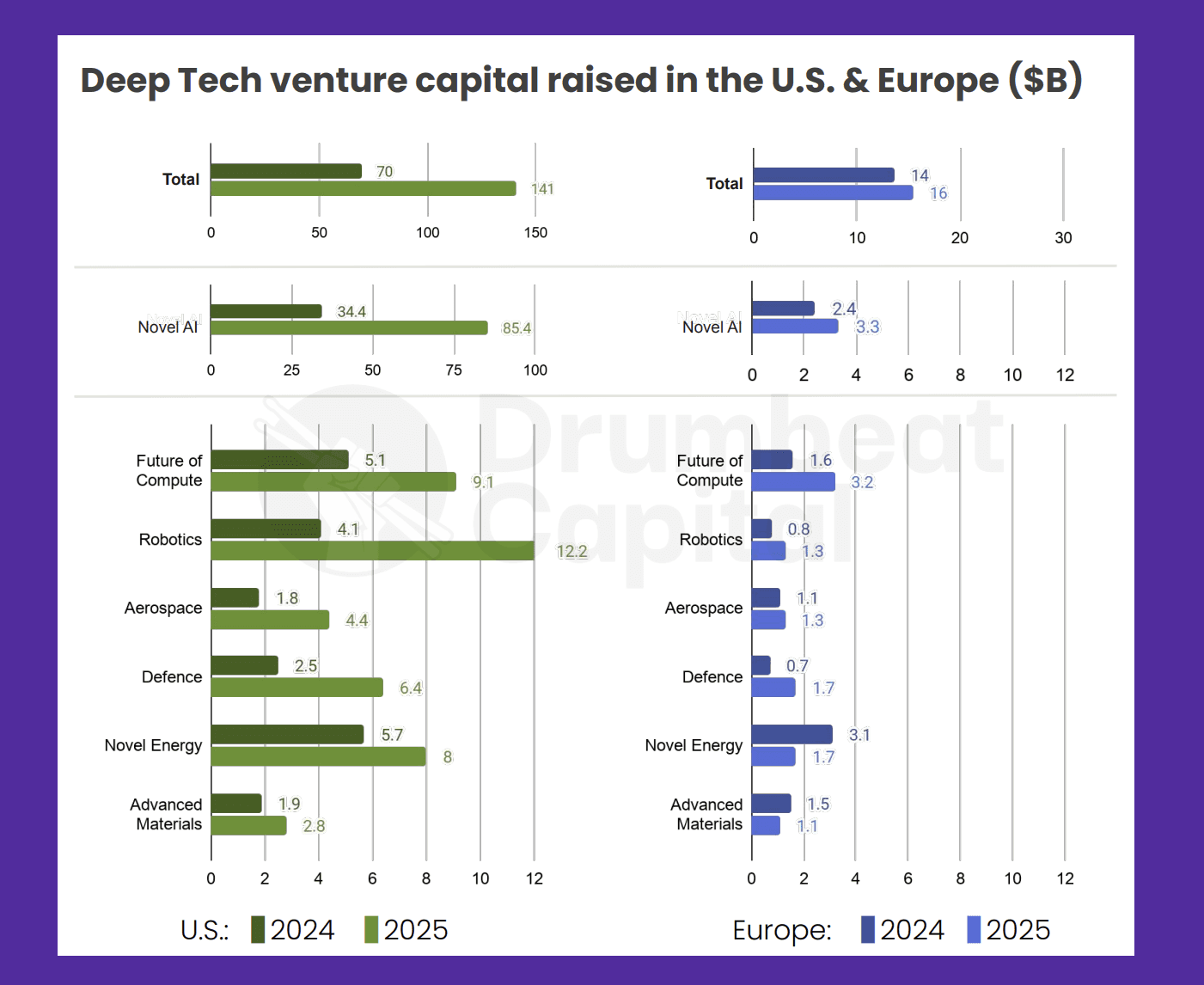
The next industrial cycle will not be won in dashboards. It will be built in labs, fabs, factories, launchpads, power grids, and autonomous systems.
Drumbeat Capital's 2026 Deep Tech Report is a 461-page data report published just now to create a shared definition and operating language for the global deep tech ecosystem.
Its core frame is simple: deep tech means commercializing scientific breakthroughs — and the report exists to cut through market noise with data on funding, talent, exits, sectors, and the U.S.–Europe opportunity.
Here are 5 key takeaways:
1. Deep tech is already behind the world's biggest companies.
The report finds that 7 of the top 10 companies by market cap started with deep tech heritage — from GPU computing and personal computers to chip manufacturing, communications infrastructure, and automotive reinvention.
2. The funding gap is no longer early-stage — it is scale-stage.
Across the U.S. and Europe, deep tech funding reached $156.6B — but the U.S. advantage compounds with stage: roughly 2x more early-stage funding, widening to a 16x gap at Series C+ in 2025.
3. Europe has the talent base — but not yet the scale machine.
Europe has 2x more STEM graduates, 2x longer tenure, and 2–5x lower salaries compared with the U.S., while 50% of top technical universities are in the U.S. and 30% in Europe. The report's strategic conclusion is clear: Europe's engineering depth needs U.S.-style capital depth and commercial scale.
4. The transatlantic bridge is the strongest deep tech platform available.
The U.S. and Europe represent roughly 50% of global GDP, with U.S. GDP at $31T, Europe at $27T, and China at $20T; they are also the world's largest trading partners, with $617B in U.S. goods exports to Europe and $840B in European goods exports to the U.S.
5. Deep tech value creation is real — but Europe is under-capturing it.
Private deep tech enterprise value stands at $3.9T, close to $4.6T for regular tech, while 60% of deep tech unicorns are in the U.S. and only 10% in Europe. The report also notes that Europe has no $100B+ deep tech company founded after 2005, making the scale-up gap the central strategic bottleneck.
On June 30, the Deutscher KI Gipfel lands at the MHP Arena in Stuttgart — bringing together 1,200 decision-makers, 60+ speakers, and four stages for one question that matters more than ever: what is already working in AI, and what can German industry actually replicate?
The KI Gipfel has been founded and put together by A11 and is cohosted by INXM. It's not another abstract AI conference. The agenda is built around operational use cases, Mittelstand reality, and the companies already moving from pilots to implementation. Expect decision-makers and operators from Trumpf, Mercedes-Benz Group, Thyssenkrupp Automotive, SAP, Bosch Mobility, Heraeus, Staffbase, Project A, and more.
Deutscher KI Gipfel 2026 — one-day summit, four stages, 60+ speakers
June 30, 2026, from noon
MHP Arena, Stuttgart
Audience: 1,200 decision-makers from German Mittelstand, industry, finance, manufacturing, and enterprise
Cosa, founded by Levi Yosef, connects call transcripts, CRM data, and communication signals to map the business case, identify deal blockers, and define what needs to happen next to close complex B2B deals. Cosa clients closed their first two high-ticket deals with €850K average transaction values within the first six weeks, despite typical sales cycles of four to six months. Levi and Cosa are offering DTM readers a free "Unstuck Your Deal" sales-coaching session; reply "COSACOSA" to enter.

